
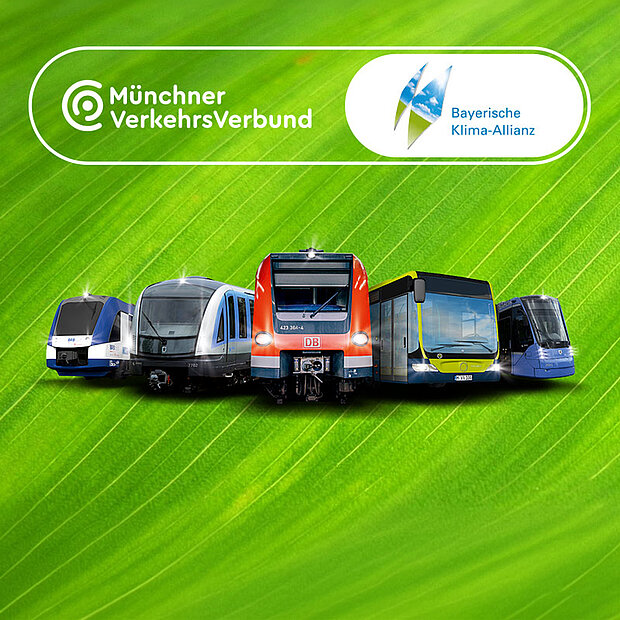
MVV’s contribution to lower-emission transport
Mobility enables social participation and economic development. At the same time, the transport sector accounts for a significant proportion of greenhouse gas emissions. Local public transport can help to reduce transport-related emissions per passenger carried.
Within the Munich Transport and Fare Association (MVV) area, large numbers of passengers use buses and trains every day for commuting, leisure travel and running errands. By carrying many passengers in a single vehicle, the average greenhouse gas emissions per passenger-kilometre are lower than when travelling by car.
The MVV is part of the Bavarian Climate Alliance and, together with transport operators, supports measures to promote sustainable mobility.
How much greenhouse gas emissions does public transport cause?
Greenhouse gas emissions vary depending on the mode of transport and passenger load. According to the Association of German Transport Operators (VDV), public transport produces, on average, fewer greenhouse gas emissions per passenger-kilometre than private car travel.
For example, according to the VDV:
- Cars (average occupancy): around 147 g of greenhouse gases per passenger-kilometre
- Public bus: around 60 g per passenger-kilometre
- Trams, light rail and underground: around 55 g per passenger-kilometre
Actual figures may vary depending on the type of vehicle, drive system, energy source and occupancy rate.
By using buses and trains instead of a comparable car journey, passengers can reduce their transport-related greenhouse gas emissions. The specific reduction depends on the route in question and the mode of transport chosen.
Tracing climate data transparently
Statements regarding environmental impacts should be transparent and verifiable. For this reason, MVV bases its figures on greenhouse gas emissions on published data and studies from recognised institutions and industry associations.
Further information can be found at: