Mobile despite a disability
People with disabilities will find a well-coordinated range of transport services within the MVV network. Almost all stops in the MVV area are now accessible. The new underground, bus, tram and regional train vehicles are also designed so that boarding – even with larger wheelchairs – is usually straightforward thanks to ramps and technical aids.
Barriers can also arise for people with impaired vision, hearing or sense of direction. In such cases, support is provided by special timetable formats, the MVV telephone helpline and the escort service run by the non-profit Catholic Men’s Welfare Association.
Passengers with a severe disability card and the “Certificate for free travel on public transport” are entitled to free travel on the MVV network – together with one accompanying person – provided they have a valid ticket. Further information on this follows below.
Ticket for people with disabilities
People with a severe disability who are severely restricted in their mobility require a green-orange severe disability card with a token. This card entitles the holder to free travel across the entire MVV network.
If the card bears the ‘B’ mark, this indicates that constant assistance is required. In this case, the accompanying person may travel free of charge.
No additional token is required for the accompanying person’s free travel – the card bearing the ‘B’ mark is sufficient.
Issuing of documents
The severely disabled person’s pass is issued by the Bavarian Centre for Family and Social Affairs.
The token costs €104 per year or €53 per half-year and is also available there.
Questions and Answers
No. The green disability card does not entitle the holder to free travel on the MVV network.
The pass alone does not entitle the holder to free travel on MVV transport.
- The pass with a token is valid throughout the MVV network.
- It can be used on all buses and trains within the MVV network.
- The pass is also valid in 2nd class on all local trains throughout the entire MVV fare zone
- The pass is also valid on routes that extend beyond the MVV area, provided that MVV tickets are accepted there.
Yes.
A disability card issued in any other federal state is recognised in Bavaria.
MVV: Accessible
MVV and its partners are constantly working to make stations and vehicles accessible, in order to offer people with disabilities greater comfort and safety. As not all stations, stops and modes of transport are yet fully accessible, we recommend checking the conditions at your starting point, destination and any interchange points before travelling.
Structural and technical support
- Lifts and moving walkways at stations, as well as lowerable ramps on buses and trams, make boarding, alighting and changing services easier.
- Visual and auditory guidance aids, such as stop displays or door-closing warnings, assist people with visual or hearing impairments.
- More space: Modern vehicles offer wider entrances and space for wheelchairs, pushchairs and bicycles.
- In some vehicles, there is a voice intercom with the driver at a wheelchair-accessible height.
- Tactile guide strips on platforms and at stops ensure a safe distance from the platform edge that can be felt.
- Good lighting and obstacle-free walkways improve safety and help with navigation.
- Disabled toilets are mainly located within the MVV network.
- Most kerbs have been lowered to 3 cm.
Communication support
- Displayed timetables and the timetable booklet indicate which routes operate with accessible vehicles.
- The travel information includes station maps showing lifts and ramps. The MVG also provides a network map showing escalators and lifts in the underground.
- Via individual settings in the travel information service, three walking speeds (“slow”, “normal”, “fast”) can be selected to display journey times more realistically.
- The travel information service is also available in a version for the visually impaired or as a text-only version.
- The telephone voice service distinguishes between
- fully accessible (level entry + lift access) and
- partially accessible (low-floor vehicles + access via escalator, ramp or lift).
Further tips for living well with a disability
Bavarian Centre for Family and Social Affairs (ZBFS)
Munich
Service Centre Bayerstr. 32
80335 Munich
Disability Commissioner for the State of Bavaria
The Bavarian State
Government’s Disability Commissioner Winzerer Straße 9
80797 Munich
Telephone: 089/ 12 61 27 99
Fax: 089/ 12 61 24 53
Expert support for people with disabilities
Social Security
Office Orleansplatz 11
81667 Munich
Telephone: 089/ 23 32 26 39
Fax: 089/ 23 32 79 44
Munich
Tourist Office Sendlinger Straße 1
80331 Munich
Telephone: 089/ 23 33 02 31 or
Telephone: 089/ 23 33 02 34
Fax: 089/ 23 33 03 37
Munich Airport – accessible for disabled visitors on arrival, parking and passenger check-in
Visiting the Allianz Arena in a wheelchair
Visits to Oktoberfest and personalised guided tours of the Wiesn
Accessibility on buses and trains
The MVV fleet is constantly being modernised. The newer the vehicle, the fewer barriers there are for people with reduced mobility.
S-Bahn
- Around 85% of the 150 S-Bahn stations are accessible; over 90 stations are considered to be optimally designed.
- Modernised vehicles from the ET 420 and ET 423 series operate on the routes, featuring wide doors, clear displays and a modern information system.
- The trains are equipped with folding ramps operated by the train crew. Wheelchair users should position themselves at the front of the train so that they can be seen.
- Multi-purpose areas are located at the very front and rear of the train, near the driver’s cabs, and are easily accessible for wheelchairs.
- There are designated seats for passengers with reduced mobility.
Information on lifts:
The 3S control centre of Munich Station Management provides information on the operational status of the lifts: 089 / 1308 1055.
In the event of a lift malfunction, the emergency call button inside the lift or at the stop can be used.
Underground
- All 100 underground stations are accessible.
- C-series trains feature wide doors, plenty of standing space and folding seats.
- Wheelchair users should always position themselves at the front of the train.
Information on underground lifts:
Operations Control Centre: 089 / 21 91 33 33.
The emergency call button is also available in the event of a lift malfunction.
Tram
- The tram network consists almost exclusively of accessible trams, even at night.
- Of 148 stops, 126 are accessible.
City buses
- Low-floor buses with folding ramps operate within the city limits; these can be identified by the wheelchair symbol.
- Recommended procedure when boarding via the ramp:
- Wait near the bus stop pole, keeping a distance from the kerb
- Use the middle door
- Press the red button to the right of the middle door to inform the driver
- The ramp will be extended once passengers have boarded and alighted
- The ramp can support up to 250 kg
- The boarding area is opposite the middle door; it is recommended that you stand with your back to the direction of travel.
- Designated seats for passengers with reduced mobility are located near the door.
- To alight, press the red button on the platform as well.
MVV regional bus
- Here too, the majority of buses are low-floor buses with a folding ramp.
- In the Rosenheim, Miesbach and Bad Tölz–Wolfratshausen districts, some high-floor buses are still in use.
- Information on the accessibility of individual vehicles can be obtained from the relevant transport operator (contact details are shown at the bottom right of the timetables).
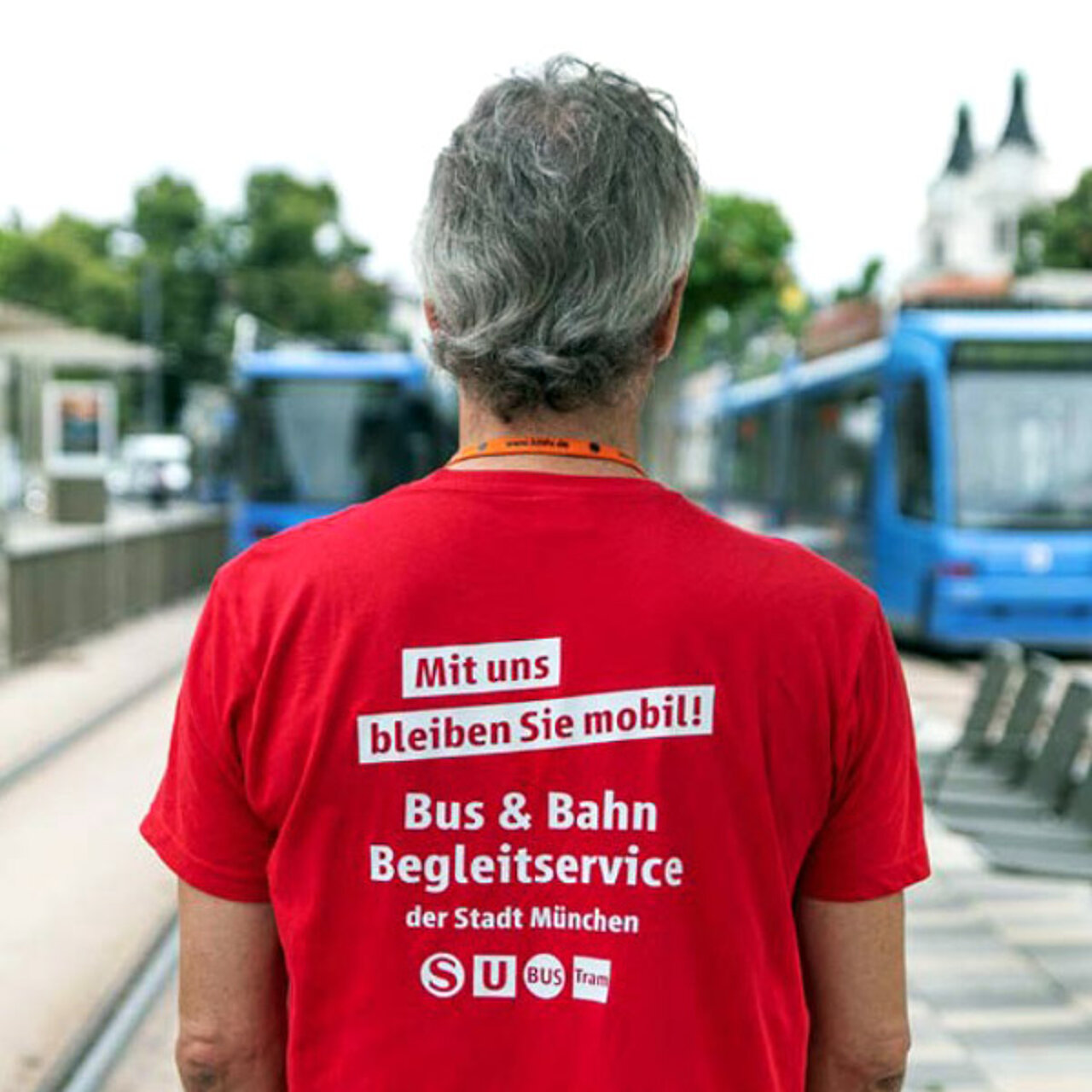
Since 15 September 2015, the City of Munich has been offering a free escort service for buses and trains on the local public transport network. The service is aimed at passengers with reduced mobility and forms part of the Munich Employment and Training Programme (MBQ).
How the escort service works
- Escort services are available Monday to Friday from 8 am to 6 pm.
- The service covers the entire Munich city area.
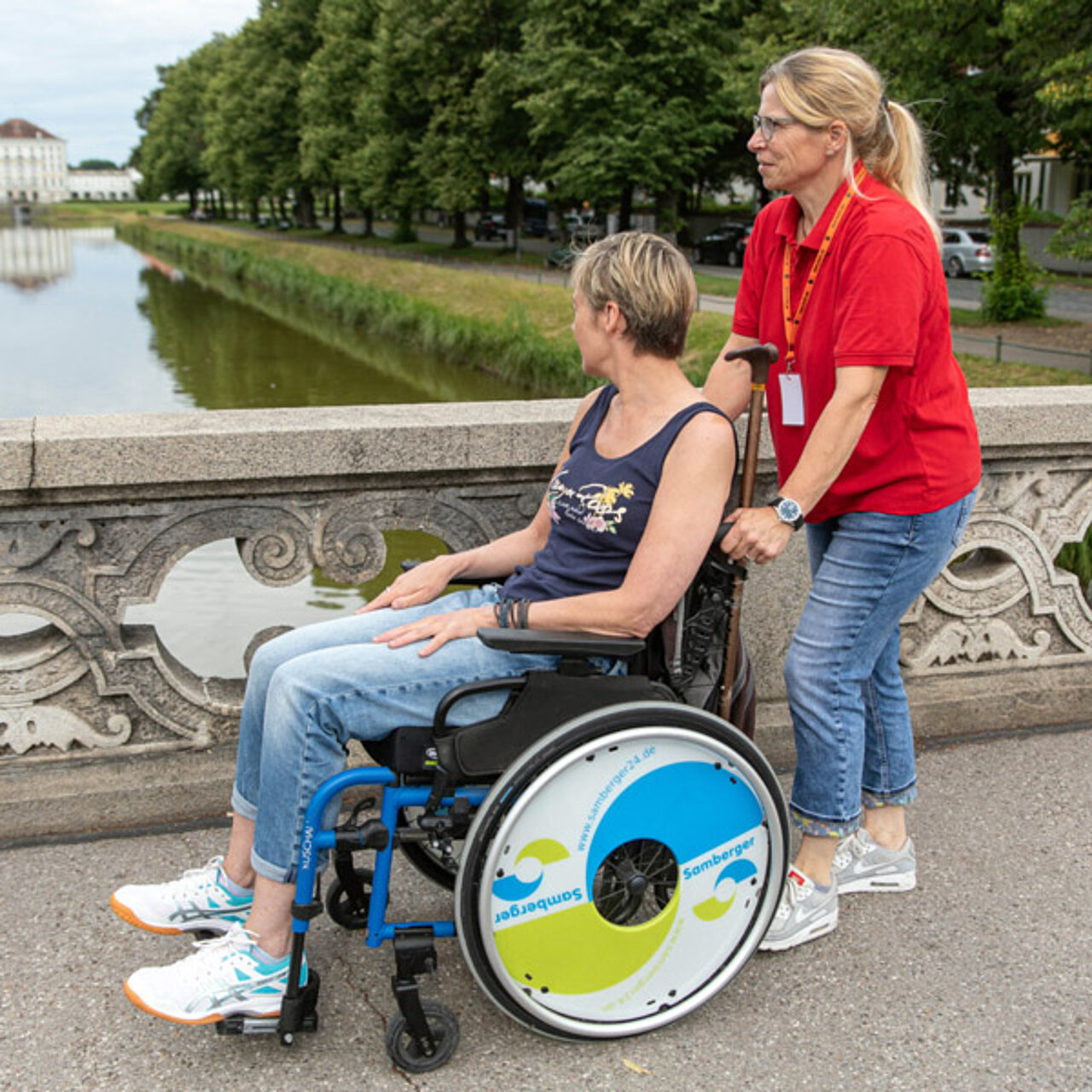
- The mobility assistants collect passengers from the agreed meeting point and accompany them to their destination. They can be recognised by their labelled uniforms.
- During the journey, they assist with buying tickets, push wheelchairs, support people with walking difficulties, or guide visually impaired and blind people.
- Escort requests can be made at the earliest one week and at the latest two working days in advance.
- No later than one working day before the appointment, the escort service will confirm whether the escort can be provided and will provide the name of the escort.
Contact for enquiries
Bookings: Monday to Friday, 9 am–4 pm
Telephone: 089 / 544 91 89 20
Website: https://stadt.muenchen.de/infos/mobil-in-muenchen.html