
Findings of the “Mobility in Germany 2023” study for the MVV area
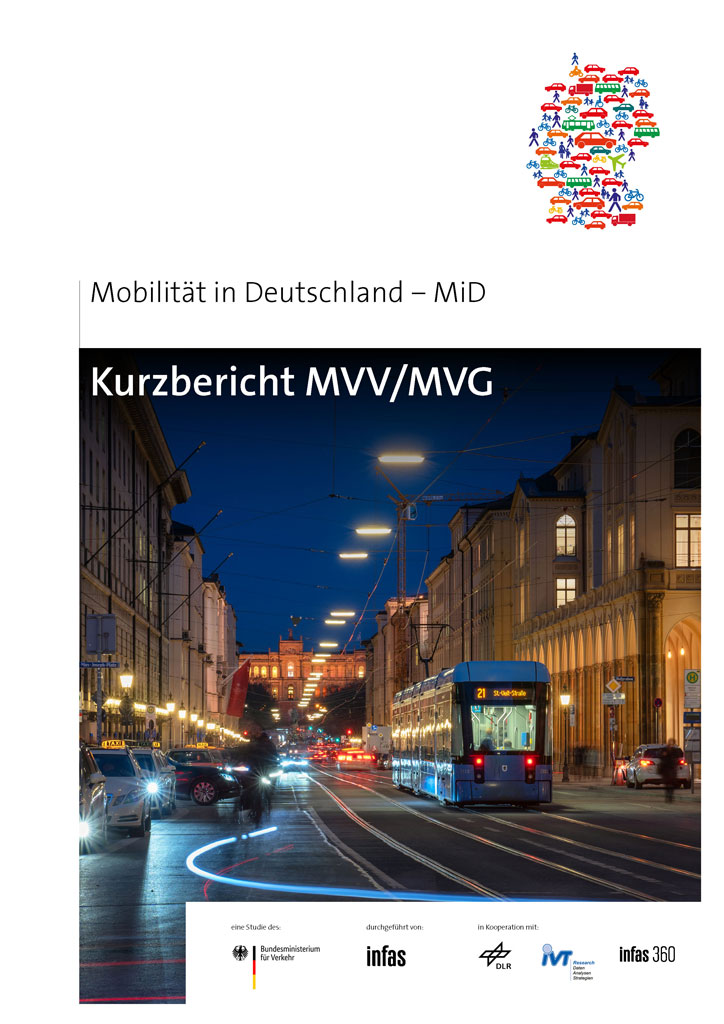
The latest study, ‘Mobility in Germany 2023’, reveals a significant shift in everyday mobility within the MVV area. Overall, people are travelling less than they did in 2017: the number of journeys, the distance travelled and the time spent travelling each day have all fallen. At the same time, the proportion of private motorised transport is declining, whilst walking, cycling and public transport are gaining in importance.
This trend is particularly evident in the modal split: the share of car traffic is declining, whilst walking and public transport are on the rise. The Deutschlandticket is also contributing to the stabilisation and slight recovery of public transport and is used more frequently than average in the MVV area. Nevertheless, the car remains an important part of mobility, particularly in the surrounding areas, whilst sustainable modes of transport dominate in the city of Munich.
Overall, there are many signs pointing to a slow but steady shift in mobility habits. New options such as sharing services or e-bikes are gaining in importance, but so far still play a minor role. For the future, it will be crucial to further expand public transport as well as walking and cycling in order to drive the mobility transition forward in a sustainable manner.
In addition to the Federal Ministry of Transport, the study involved, among others, the infas Institute for Applied Social Sciences, the German Aerospace Centre (DLR), IVT Research GmbH and infas 360 GmbH in cooperation with MVV and MVG, as well as numerous other regional partners.
A summary of the findings is available to download as a PDF.