Since 1972, the following has applied
1 network. 1 timetable. 1 ticket.
To this day, this guiding principle remains synonymous with the purpose of the Munich Transport Association.
But public transport has been taking people to their destinations in and around Munich for around a century and a half. Here is a brief look back at its history:
The beginnings of public transport
Public transport in Munich before the network was founded
The history of local public transport in Munich dates back to the 19th century. As early as 1840, the first local railways ran from the city to the surrounding area, forming early connections between Munich and the neighbouring communities.
From 1861, horse-drawn carriages were put into service. They are regarded as the precursors of today’s bus services. In 1876, the first horse-drawn tram began operating, followed in 1883 by the steam-powered tram. With advancing technical development, the electrification of the tram network began in 1895 by the Münchner Trambahn-Actien-Gesellschaft. This gradually replaced the existing horse-drawn and steam trams.
Initially, the tracks were mainly served by small, two-axle motor cars (‘Z-cars’). By 1900, the Munich tram network already had a fleet of 507 vehicles, supplemented by 7 steam tram locomotives and 6 battery-powered locomotives.
Bus transport developed in parallel with the tram. From 1898, the first bus routes operated by Motorwagen-Gesellschaft München AG – a predecessor of today’s Autobus Oberbayern – supplemented the existing network. In 1906, the first regular scheduled service with motorised buses began.
Well into the 20th century, trams and buses formed the backbone of public transport in Munich.
Suburban railways such as the Isartalbahn provided connections to the surrounding area. These routes were later integrated, either fully or partially, into the Munich S-Bahn, significantly improving accessibility to the region.
Munich’s rapid growth into a metropolitan region was accompanied by a continuous expansion of local transport. Despite the growing range of services, however, travel remained confusing and expensive for a long time. A journey from the surrounding area into the city often required several tickets: one for the bus to the suburban railway station, another for the train journey into the city, and often a third for inner-city transport.
This situation made it clear that a unified and coordinated system was necessary – a realisation that later led to the establishment of the Munich Transport and Tariff Association.
A crucial turning point
By the mid-20th century, the situation had worsened. Buses and trams were increasingly congested on the roads. In 1953, the city established the Study Group for the Construction of a Munich Overground and Underground Railway. It recommended the construction of an underground railway. Consequently, eight underground lines were planned.
In 1965, construction of the first line began with the ground-breaking ceremony for the U6 line.
At the same time, the state capital agreed with the federal government, the Free State of Bavaria and the Deutsche Bundesbahn on the construction of the Munich S-Bahn. It was intended to connect the suburban railways and pass through the city centre via a tunnel. Both decisions proved to be groundbreaking – particularly with a view to the 1972 Summer Olympics.
One system for all
With the expansion of transport networks, the issue of fares came into focus. The coexistence of different ticketing systems was deemed unsustainable. The aim was a unified system that would enable quick and easy journeys with a single ticket.
On 26 July 1968, negotiations began between the Free State of Bavaria, the City of Munich and the Deutsche Bundesbahn to establish a transport and fare network for the Greater Munich area. From 1969 onwards, federal ministries were also involved.
The MVV is formed
The agreement was signed at the end of 1971. It laid the foundations for
- the foundations of a transport and fare network,
- the MVV’s articles of association and organisational agreement,
- as well as the rules governing the distribution of revenue between the city and the railway.
Among the initial objectives were:
- providing the public with information at an early stage,
- fully equipping the stops,
- and the timely publication of the integrated transport timetable.
Launch of the MVV network
Regular operations began on 28 May 1972. The new integrated network comprised 1,500 stops across approximately 1,400 kilometres. The integrated area covered 5,000 square kilometres with a population of 2.1 million.
A standardised timetable ensured shorter transfer times, more frequent services and more space. The integrated fare system was particularly well received, as it introduced standardised tickets and prices for the first time.
The trial run during the Olympic Games also went smoothly.
The first 20 years of MVV
Between 1973 and 1982, the number of journeys rose from 358 million to 464 million. Despite a declining population in the urban area, the transport situation improved significantly.
By 1992, demand had grown to 535 million journeys.
The underground and suburban rail networks continued to form the backbone of the transport network. The underground network grew to over 60 kilometres, and the suburban rail system was extended with additional tracks.
Passenger information services were also modernised. With the introduction of electronic timetable information (EFA), digital information systems became available for the first time, including touchscreens at Munich Airport. As ticket prices did not cover the actual costs, the shareholders made up the shortfall.
The MVV as a public transport authority
Following the rail reform, the MVV became a transport authority association on 30 April 1996. The Free State of Bavaria, the City of Munich and several districts became shareholders.
On 10 December 2023, the MVV expanded once again: the district of Miesbach and the city and district of Rosenheim became part of the network area. The district of Bad Tölz-Wolfratshausen has also been fully integrated since then. In the years that followed, the network area was further expanded to include the districts of Landsberg am Lech, Weilheim-Schongau, Garmisch-Partenkirchen, Landshut (including the city of Landshut) and Mühldorf am Inn.
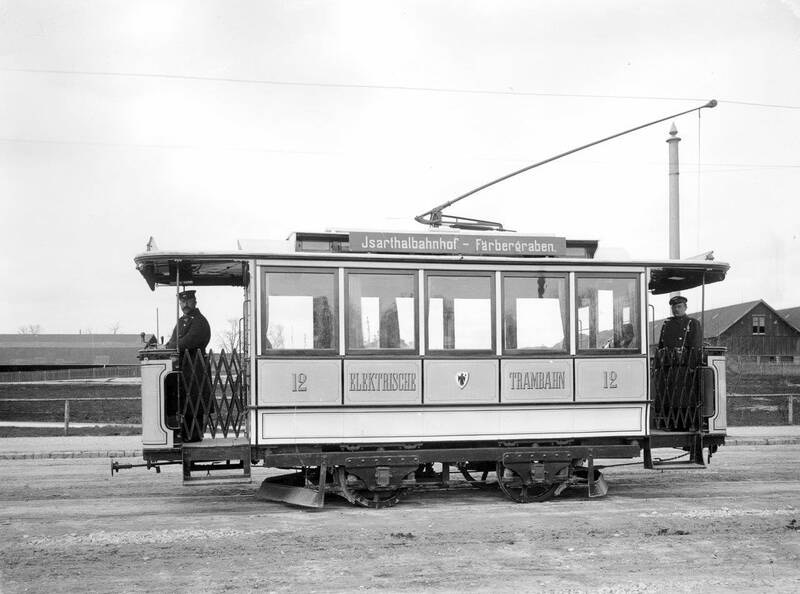
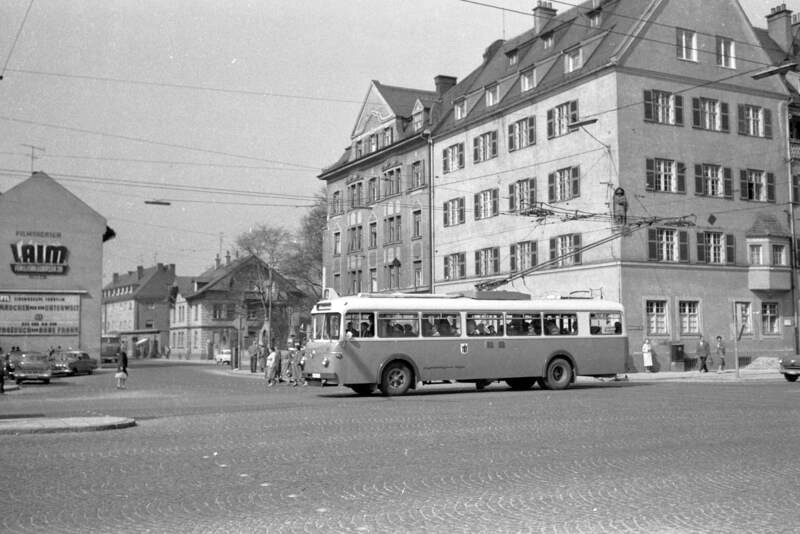
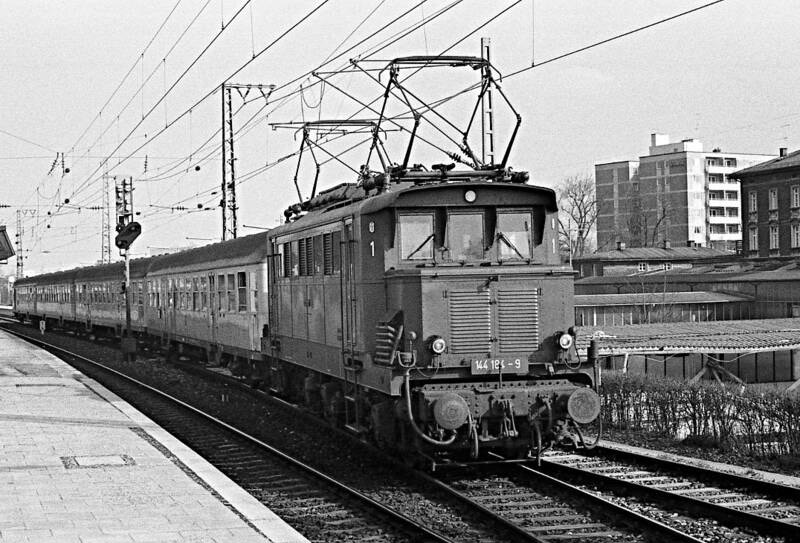
Foto und Info: Isartalbahner
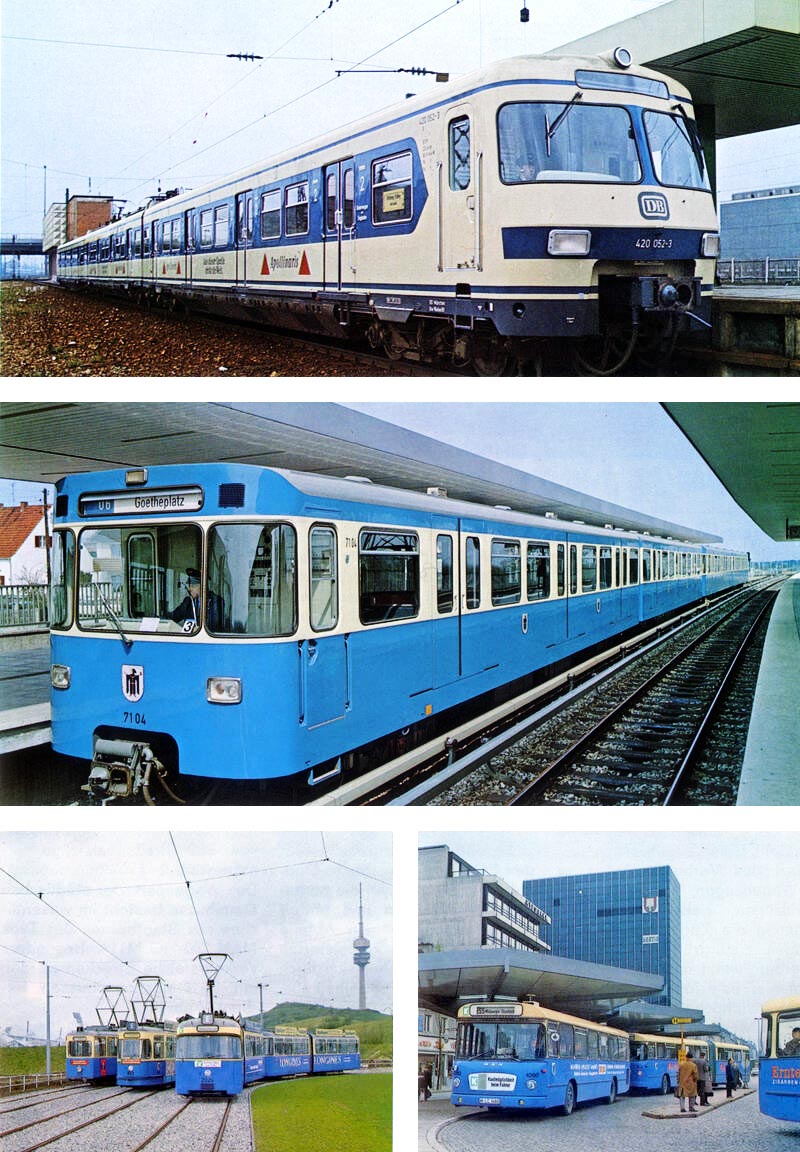
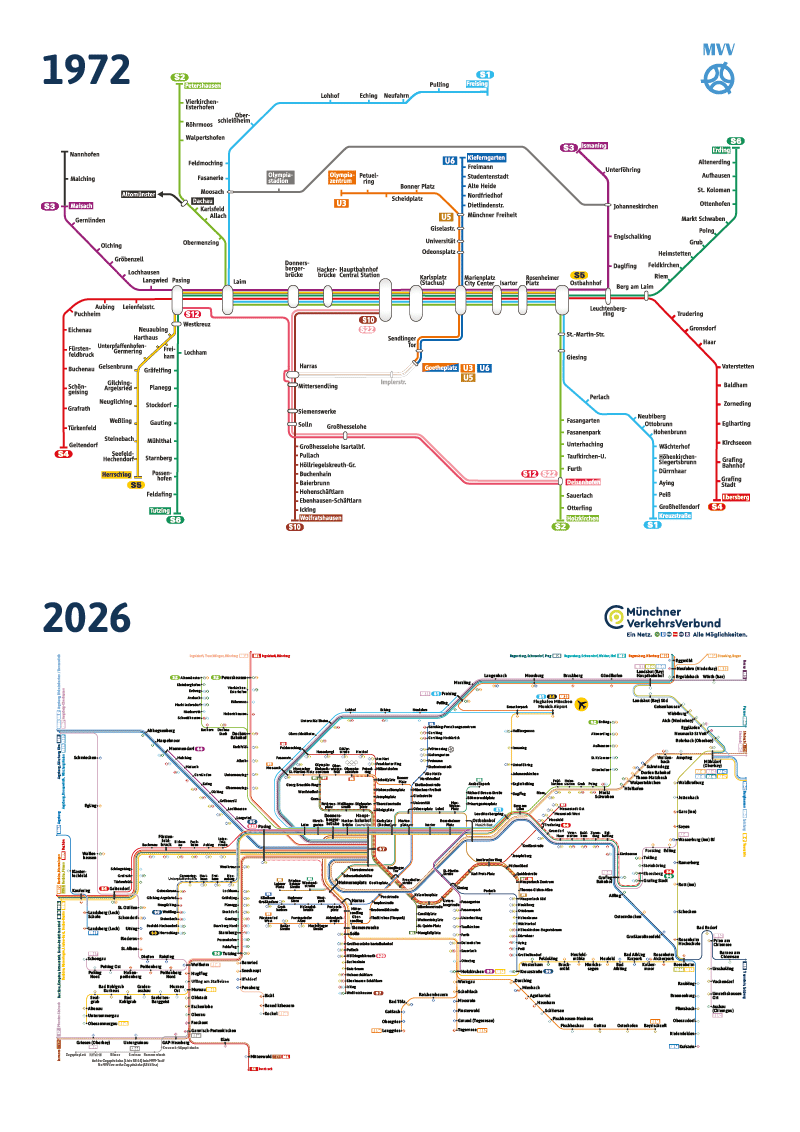
(Click on the image to download the PDF)
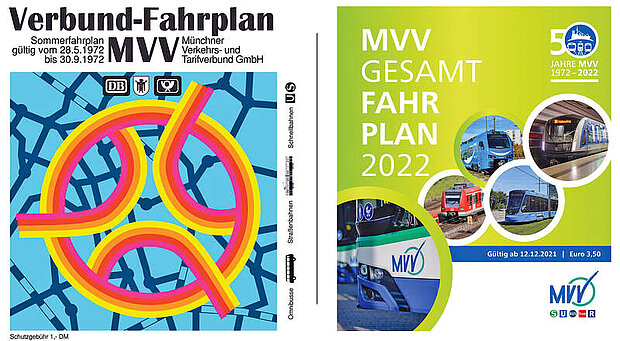
Information on paper
The Comprehensive Timetable Book (1972–2022)
The image on the right shows the first and, at the same time, the last “Große Fahrplanbuch” published by the MVV for its passengers. It contained the timetables for all routes that could be used with an MVV ticket.
An anniversary edition for the 2022 timetable year marked the end of the era of this printed transport guide after 50 years.
However, printed timetable media from the MVV are still available. In the MVV district booklets, mini-timetables and numerous brochures, passengers can find almost all the information that is also available digitally on the website and in the MVV app.
Milestones in MVV’s history
Chronicle
1966
26 April 1966
: Munich is awarded the contract to host the XX Summer Olympic Games in 1972.
4 May 1966
A dedicated underground construction department is established.
15 June 1966
: Construction of the Munich S-Bahn begins on Arnulfstraße, opposite the main station.
1967
10 May 1967
: Construction of the Olympic underground line begins.
1968
20 April 1968
: The last day of service for tram line 3 between Milbertshofen and Harthof.
21 April 1968
Last journey of tram line 19 along Kaufingerstraße/Neuhauser Straße.
26 July 1968
Establishment of the Joint Commission to prepare for the Munich Transport and Tariff Association by the Free State of Bavaria, the City of Munich and the Deutsche Bundesbahn.
1970
28 February 1970
: The last day of service for tram line 22 between Schwabing and Ratzingerplatz.
26 November 1970
Opening of the Stachus underground level.
1971
5 April 1971
: MVV GmbH is founded. The shareholders are the Deutsche Bundesbahn and the City of Munich, each holding an equal share.
May 1971
: Deutsche Bundesbahn and Deutsche Bundespost establish the Omnibusverkehrsgemeinschaft (OVG).
18 May 1971
First meeting of the MVV Supervisory Board. Lord Mayor Dr Hans-Jochen Vogel is appointed Chairman of the Supervisory Board.
1 June 1971
MVV commences operations. Walter Layritz, representing the City of Munich, and Nikolaus L. Meyer, representing the Deutsche Bundesbahn, are appointed as managing directors of MVV GmbH.
23 September 1971
Chancellor Willy Brandt visits the Munich Underground.
19 October 1971
The U6 becomes the first underground line to commence operations on the 12-kilometre route between Kieferngarten and Goetheplatz.
1972
28 April 1972
The S-Bahn tunnel section from the main station via Marienplatz to Ostbahnhof opens.
8 May 1972
Opening of the 3.6-kilometre-long U3 Olympic underground line between Münchener Freiheit and the Olympic Centre.
26 May 1972
Last day of operation for tram line 39 between Gondrellplatz and Michaelibad.
27 May 1972
Last day of operation for tram line 6 between Harthof and Lorettoplatz.
28 May 1972
Commencement of S-Bahn services.
Start of integrated transport in Munich. S-Bahn, underground, trams and buses operate as part of a single network. The first integrated timetable comes into force.
30 June 1972
Official opening of the pedestrian zone.
22 August 1972
Lord Mayor Georg Kronawitter becomes Chairman of the Supervisory Board of the MVV.
26 August 1972
Start of the XX Summer Olympic Games in Munich.
1 October 1972
The S4 S-Bahn line begins operating between Grafrath and Geltendorf.
1 December 1972
The Supervisory Board and the General Meeting of Shareholders decide to discontinue the first-class surcharge with immediate effect.
1973
1 February 1973
: Dieter Lippert becomes Managing Director of MVV.
Smoking compartments on the S-Bahn are abolished.
It is now possible to combine a season ticket with a single-journey fare.
2 June 1973
The S1 runs every 20 minutes throughout the day between Moosach and Neubiberg.
The S-Bahn line S1 commences operation on the section between Hohenbrunn and Kreuzstraße.
The S4 operates at 20-minute intervals all day between Pasing and Trudering.
1 August 1973
Introduction of the term “24-hour ticket” to replace “day and tourist ticket”.
1 September 1973
The first issue of the customer magazine “MVV-Telegraf” is published.
30 September 1973
The S-Bahn line S3 begins operating on the section between Ostbahnhof and Ismaning.
A 20-minute service is introduced all day between Lochhausen and Johanneskirchen – as is the case during rush hour between Johanneskirchen and Ismaning.
1 October 1973
In addition to senior citizen tickets, retirement tickets are issued to pensioners under the age of 65 on low incomes.
25 November 1973
The first of a total of four car-free Sundays is a response to the energy crisis. The approximately 200,000 additional passengers in the network are transported without difficulty.
1974
26 May 1974
The average pay rise is 17.9 per cent.
The rule ‘number of zones determines number of strips’ is introduced.
The 5-day weekly and monthly tickets are discontinued – only 7-day weekly and monthly tickets are available.
The S6 line begins running every 20 minutes during rush hour to Tutzing.
7 July 1974
The World Cup final is held in Munich. The German national team defeats the Netherlands 2–1.
1 August 1974
The student fare is restructured into Student Fare I and II.
1 September 1974
The first regular taxi service runs from the student quarter to Wieslocherstraße.
29 September 1974
The S1 runs every 20 minutes during rush hour between Oberschleißheim and Freising.
1975
1 February 1975
The ‘Verbundpass’ is a new travel pass.
30 May 1975
The last journey with a conductor takes place on tram line 29. Tram line 9 from Gondrellplatz to Cosimapark operates for the last time. It is replaced by lines 19 and 20.
1 June 1975
The “MVV Hiking Programme” is launched. Starting from 34 hiking stations, 111 hiking trails covering over 1,000 kilometres are signposted by the MVV with specially designed markings.
The “Family Hiking Pass” is launched as a new fare offer.
The S5 no longer serves Freiham S-Bahn station because the planned large-scale housing development is put on hold.
The S2 is extended from Deisenhofen to Holzkirchen and runs every 40 minutes.
22 November 1975
The legendary tram line 8 makes its final journey from Scheidplatz to Fürstenried-West – after 75 years of service. Tram line 23 from Harthof to Steubenplatz also ceases operations.
23 November
Lines U3 and U6 are extended by 2.7 kilometres from Goetheplatz to Harras.
1976
1 January 1976
Fares are increased by an average of 18.5 per cent
18 March 1976
Regionalverkehr Oberbayern GmbH (RVO) is founded.
1 April 1976
Token pouches are introduced for season tickets.
1 May 1976
A fare scheme for groups of young people accompanied by adults is introduced.
23 October 1976
The tramway celebrates its 100th anniversary. In the year it was founded, the horse-drawn tram carried 390,000 passengers.
18 December 1976
The S3 is given its own S-Bahn tracks for the 6.7-kilometre route between Lochhausen and Olching. All-day 20-minute services to Olching are introduced.
1977
28 May 1977
: 5 years of MVV.
14 October 1977
The “MVV cinema ticket” is introduced as a new fare option.
17 December 1977
Two new S-Bahn stations are in operation: Neuperlach Süd and Unterschleißheim.
1978
1 May 1978
The fare scheme for young people accompanied by adults is relaunched.
28 May 1978
The Poccistraße underground station is completed.
The regional bus service in the Munich district is reorganised and integrated into the MVV.
The S6 runs to Starnberg every 20 minutes throughout the day on Saturdays, Sundays and public holidays.
The Munich district officially becomes part of the transport association.
14 June 1978
Lord Mayor Erich Kiesl becomes Chairman of the MVV Supervisory Board.
1 November 1978
The restricted period for senior citizen tickets is brought forward from 6.30 pm to 6 pm.
1979
1 January 1979
The standard postage rate is increased from 20 marks to 40 marks, and a reminder fee is introduced.
3 February 1979
A new fare offer brings a 40 per cent discount – thanks to a partnership with “Caravan und Boot”.
23 February 1979
The “MVV Carnival Ticket” is launched.
5 May 1979
As part of the Munich Europe Weeks from 5 to 20 May 1979, the “MVV Euro Ticket” is launched.
27 May 1979
The regional bus service in the district of Ebersberg is reorganised.
The S2 begins running every 20 minutes between Petershausen and Dachau.
The district of Ebersberg officially becomes part of the transport network.
1 August 1979
As a trial, the afternoon restrictions on senior citizen tickets during the holidays are lifted.
1 October 1979
New regulations for free travel for severely disabled passengers.
3 November 1979
The S4 is given its own S-Bahn tracks between Trudering and Haar along a 5.3-kilometre stretch.
All-day 20-minute services to Haar are introduced.
21 December 1979
A section of the ceiling collapses at Marienplatz underground station; three people are injured.
1980
1 January 1980
Fares are increased by an average of 30 per cent.
A regional bus fare is introduced for the first time.
For senior citizen tickets, the restricted period during the holidays in the mornings is abolished.
7 January 1980
The regional bus service in the Erding district is reorganised.
The Erding district officially becomes part of the transport network.
28 May 1980
The S3 is given its own S-Bahn tracks on the 5.3-kilometre route between Olching and Maisach.
A 20-minute service during peak hours is introduced.
Esting opens as a new S-Bahn station.
1 June 1980
Reorganisation of regional bus services in the district of Fürstenfeldbruck.
The district of Fürstenfeldbruck officially becomes part of the network.
1 August 1980
Erich Steinhögl becomes MVV Managing Director.
14 August 1980
The most important employee is born.
18 October 1980
Last day of operation for tram lines 1 from Moosach to Steinhausen, 2 from Scheidplatz to Waldfriedhof, 7 from Petuelring to Schwanseestraße, 11 from Moosach to Maximiliansplatz and 24 from Ostbahnhof to Neuperlach Zentrum.
19 October 1980
The U8 comes into service. It runs 16 kilometres from the Olympic Centre to Neuperlach Süd.
19 November 1980
Visit by Pope John Paul II to Munich. Around one million visitors attend the closing ceremony at the Theresienwiese. With the help of S-Bahn and U-Bahn carriages from Stuttgart and Nuremberg, the traffic is managed without any problems.
26 November 1980
Mayor Helmut Gittel becomes Chairman of the Supervisory Board of the MVV.
22 December 1980
Further changes to senior citizen tickets: the restricted period during the holidays is completely abolished. The same applies to Shrove Tuesday.
1981
1 April 1981
The “MVV Congress Ticket” is introduced as a new fare option.
10 April 1981
The “MVV Family Pass” is launched.
31 May 1981
The S7 S-Bahn line begins operating between Ostbahnhof and Wolfratshausen. It runs all day at 20-minute intervals as far as Höllriegelskreuth. The line extension and 14 additional ET 420 multiple units cost around 210 million marks.
The S22 now runs as the S27 via Donnersbergerbrücke S-Bahn station to Starnberg station. Großhesselohe S-Bahn station is no longer served.
The S6 will operate at 20-minute intervals – during peak hours between Markt Schwaben and Erding.
The Giesing rapid transit hub is served every 10 minutes throughout the day from Monday to Friday.
June 1981
The MVV information desk at the main station begins operations.
1 October 1981
The range of fares is expanded to include the "City Ticket".
19 October 1981
10 years of underground rail operations in Munich – to mark the occasion, Stadtwerke München Verkehrsbetriebe unveils the first new-generation underground carriages featuring three-phase technology.
1982
15 May 1982
Bicycles are permitted on suburban and underground trains.
23 May 1982
The regional bus service in the districts of Bad Tölz/Wolfratshausen and Starnberg is reorganised.
The districts of Bad Tölz-Wolfratshausen and Starnberg officially become part of the transport association.
28 May 1982
10 years of the MVV.
13 September 1982
Regional bus services in the district of Dachau are reorganised.
The Dachau district officially becomes part of the transport association.
26 September 1982
The Heimeranplatz S-Bahn station opens. The S7 and S27 services operate there.
1983
1 February 1983
Start of construction: The U3 is extended by 8 kilometres from Implerstraße to Fürstenried West.
26 March 1983
The ban on carrying bicycles on Saturdays, Sundays, public holidays and during school holidays is lifted.
17 April 1983
The U3 and U6 are designated as ‘flower lines’ for the International Horticultural Exhibition (IGA). The 2.7-kilometre section from Harras to Holzapfelkreuth is extended accordingly.
28 April 1983
International Horticultural Exhibition from 28 April to 9 October.
28 May 1983
Last day of operation for tram lines 4 from Hanauer Straße to St.-Veit-Straße, 17 from Amalienburgstraße to Wettersteinplatz and 21 from Amalienburgstraße to Maximiliansplatz.
29 May 1983
The U1 becomes an independent line: the new, 3.3-kilometre-long section between Rotkreuzplatz and the main station is completed. It now runs between Rotkreuzplatz and Innsbrucker Ring.
The first-class carriage on the S-Bahn is removed from the fare structure.
1984
2 February 1984
: Launch of the MVV Btx programme. Videotex is used to provide information to passengers.
10 March 1984
Last day of operation for tram line 14 from Gondrellplatz to St.-Veit-Straße.
11 March 1984
The first 4.6-kilometre section of the U5 is completed. It runs from Westendstraße to Karlsplatz (Stachus) – via the Theresienwiese and Messegelände stations.
1 May 1984
Lord Mayor Georg Kronawitter becomes Chairman of the Supervisory Board of the MVV.
1 June 1984
Fares are increased by an average of 8.3 per cent.
3 June 1984
Regional bus services in the municipalities of Neufahrn and Eching in the district of Freising are integrated into the MVV fare system.
The 20-minute service interval on the S6 is extended to Starnberg, and similarly on the S1 to Hohenbrunn.
The S7 is introduced with a 20-minute service interval for the first time on the route between Ostbahnhof and Höllriegelskreuth – including on Saturdays, Sundays and public holidays
8 August 1984
The special service S11, previously operated only sporadically, is established as the S8. It runs to all football matches at the Olympic Stadium.
30 September 1984
The 2.7-kilometre double-track S-Bahn section between Freiham and Unterpfaffenhofen Germering is put into service for the S5.
1985
1 March 1985
A smoking ban is introduced in underground stations.
2 June 1985
The S1 line begins running every 20 minutes to Oberschleißheim.
The S2 line operates a 20-minute service to Taufkirchen all day on Saturdays.
29 September 1985
To mark the opening of the “Am Gasteig” cultural centre, a “cultural timetable” is introduced between 10.00 pm and 11.30 pm. This guarantees a 20-minute service in the inner-city area after events in Munich have finished.
The S5 begins operating on the 5-kilometre section from Gilching to Weßling, which has now been upgraded to double track.
The U1 is extended via the Innsbrucker Ring to Neuperlach Süd.
October 1985
Construction of the airport S-Bahn begins.
5 October 1985
The MVV Btx timetable programme is available for viewing at public terminals.
1986
1 January 1986
Fares are increased by an average of 4.4 per cent.
The afternoon restriction for senior citizens is abolished.
Season ticket prices will vary depending on whether the journey is within or outside the city limits.
Weekly tickets are introduced for student fares.
The Youth Pass is valid until the age of 21.
The age limit of 35 is abolished for Student Fare II.
The MVV season ticket is here: customers travel for 12 months but only pay for 10.5 months
1 March 1986
The U5 is extended by 0.7 kilometres – from Karlsplatz to Odeonsplatz.
1 June 1986
Season tickets are now valid until the first working day of the new week or the new month.
1 July 1986
The “Green Card” is a new fare offer.
28 September 1986
The new Loisach Bridge in Wolfratshausen is completed; the S7 line is being upgraded.
With immediate effect, there is an obligation to carry prams.
31 December 1986
On New Year’s Eve, continuous service is in operation for the first time: between 1.30 am and 5 am, services run every 30 minutes on all underground and suburban trains on the main line between Pasing and Ostbahnhof, as well as on tram lines 13, 16, 18, 19, 20 and 25.
1987
1 March 1987
: Work begins on the U2 line and the 6.9-kilometre section between Scheidplatz and Feldmoching.
31 May 1987
The double-track upgrade of the S5 between Weßling and Freiham is completed. A 20-minute service is introduced as far as Weßling.
1 August 1987
Construction begins on the U6 line and the 2.9-kilometre extension from Holzapfelkreuth to Klinikum Großhadern.
1 November 1987
Introduction of a 20-minute service on the S4 between Pasing and Buchenau.
1988
1 January 1988
Fares are increased by an average of 2.7 per cent. The MVV season ticket becomes even more attractive: customers travel for 12 months but only have to pay for 10.
24 March 1988
The U5 is extended by 1.4 kilometres from Westendstraße underground station to Laimer Platz.
29 May 1988
New to the MVV: regional buses in the Freising district and the DB rail line from Freising to Moosburg.
The district of Freising officially becomes part of the transport network.
The S3 is extended to Nannhofen.
End of service for the special S8 line to the Olympic Stadium – following the end of the European Football Championship.
1 August 1988
Introduction of a ‘Bussi-Spur’ – also known as a Kiss & Ride lane – on Lerchenauer Straße
25 September 1988
The S4 between Haar and Zorneding is given its own S-Bahn tracks over a distance of 8.3 kilometres. All-day 20-minute intervals to Zorneding are introduced.
28 October 1988
The U5 is extended by 4.1 kilometres from Odeonsplatz via Ostbahnhof to Innsbrucker Ring.
The U4 begins operating as a new line on the 3.6-kilometre route from Max-Weber-Platz to Arabellapark.
The U8 is now called the U2.
A smoking ban is introduced in the S-Bahn tunnel stations.
1989
1 January 1989
The student fare is also issued for partial journeys.
28 May 1989
Fares are increased by an average of 4.7 per cent.
There are comprehensive changes to the zone-based fare system: the system is simplified, there are fewer zones, partial journeys are no longer available, and short journeys are based on stops.
The regional bus fare is abolished.
A new annual pass costing 9.5 times the monthly fare is introduced.
The “24-hour ticket” becomes the “day ticket”, which allows additional passengers to be carried on Saturdays, Sundays and public holidays.
The previous special offers – the “Green Card”, “Group Ticket” and “Congress Ticket” – become standard offers
29 October 1989
The U3 is extended by around six kilometres to Forstenrieder Allee.
14 December 1989
Construction begins on the 3.5-kilometre extension of the U1 from Kolumbusplatz to Mangfallplatz.
1990
1 January 1990
The fare is increased from 40 marks to 60 marks.
The new area of validity for the “Green Card” is the city centre plus the first outer zone of the cash fare zone. The option to carry one additional person with a valid season ticket – on weekdays from 6 pm, and all day on Saturdays, Sundays and public holidays – is reintroduced. The commercial lending of season tickets is prohibited.
3 February 1990
The C-B-R 90 presents a touchscreen with electronic timetable information to the public.
1 May 1990
The “white-and-blue combined ticket” for journeys with Bayerische Seenschifffahrt and the MVV is introduced.
27 May 1990
The validity of the “day ticket” is extended: it is valid from Monday to Friday from 9 am, as well as all day on Saturdays, Sundays and public holidays. It is valid for up to five people, of whom no more than two may be aged 18 or over, and one dog.
Bicycles are permitted on DB trains.
30 September 1990
Freising City Transport introduces a 20-minute frequency on all routes.
1991
1 February 1991
Agreement with Allianz Insurance regarding the sale of discounted day tickets to Autocard holders. Following a ruling by the Munich Higher Regional Court on 18 July 1991, this scheme is declared anti-competitive and must be discontinued.
2 June 1991
The U3 is extended from Forstenrieder Allee via Basler Straße to Fürstenried West. Tram line 16 ceases operation.
Lines S4 and S5 are rerouted: the S5 now runs between Herrsching and Ebersberg; the S4 from Geltendorf terminates at Ostbahnhof.
1 July
Cooperation agreement with the Bavarian State Opera.
1 September 1991
Cooperation agreement with the Bavarian State Theatre and the State Theatre on Gärtnerplatz.
7 October 1991
The S1 runs every 20 minutes to Höhenkirchen-Siegertsbrunn.
1 November 1991
Fares are increased by 5 per cent for single tickets and by an average of 3.5 per cent for season tickets.
4 November 1991
Agreement reached with around 110 retail outlets that they will refund DM 1.50 upon presentation of a day ticket for the entire network.
1992
17 May 1992
: Opening of the new airport and the S8 S-Bahn line. Three new stations open: Hallbergmoos, Besucherpark and Munich Airport.
Service frequency improvements for lines S5 Herrsching, S6 Tutzing and S7 Wolfratshausen to the line termini: a 20-minute service interval applies during the day on Saturdays, Sundays and public holidays throughout the summer timetable period.
The DB rail lines Grafing Bahnhof – Aßling and Ebersberg – Tulling are included in the MVV joint fare system.
28 May 1992
The MVV turns 20.
1 October
: As a trial, viewing windows – ‘Venetian mirrors’ – are installed on the S-Bahn between the driver’s cab and the passenger compartment.
1993
1 March 1993
The MVV information desk at the main station is being refurbished.
From 8 pm, passengers on city centre buses may only board at the front. The driver checks tickets.
23 May 1993
Fares rise by an average of 12.5 per cent.
The youth pass fare is redesigned on a trial basis and made cheaper; the maximum travel times are extended by one hour. Children may travel free of charge on standard time and network tickets. The “Green Youth Card” becomes a standard offering.
The U6 is extended to Klinikum Großhadern. The approximately three-kilometre-long route runs via the underground stations Haderner Stern, Großhadern and Klinikum Großhadern.
31 August 1993
MVV Managing Director Dieter Lippert moves to the Rhine-Ruhr Transport Association.
30 September 1993
MVV Managing Director Erich Steinhögl retires.
1 October 1993
Hans-Joachim Frey-Graf and Helmut Knüttel become MVV managing directors.
November 1993
Lord Mayor Christian Ude becomes Chairman of the Supervisory Board of MVV.
21 November 1993
The U2 is extended to Dülferstraße. The new section is five kilometres long. It includes the stations Milbertshofen, Frankfurter Ring, Am Hart, Harthof and Dülferstraße.
Operation of tram line 13 is discontinued.
27 November 1993
The BMW FIZ car park opens at weekends for MVV customers.
1994
15 January 1994
The former customer magazine “Telegraf” is relaunched in a modernised format, printed in full colour, under the name “conTakt”.
28 May 1994
Launch of Line A from Dachau to Altomünster. Service standards are raised to S-Bahn level.
29 May 1994
Single-journey fares rise by an average of 7.1 per cent, season ticket fares by 4.5 per cent.
1 July 1994
The U6 is extended by one kilometre from Kieferngarten to Fröttmaning. The new P+R car park has 1,200 car spaces and 80 spaces for buses.
13 September
A new night-time network is launched. Tram routes N19, N20 and N27, and bus routes N33, N68, N72, N89 and N95 operate every day. At weekends, bus route N91 also runs. Services run hourly
20 September 1994
Collapse of the Trudering underground station, which was under construction. A bus on route 192 plunges approximately ten metres, killing three people.
11 October 1994
New low-floor multiple units enter service: these trams are quieter and easier to board thanks to a low step. They also feature a ramp to assist wheelchair users in boarding.
October 1994
The platforms at Markt Indersdorf, Schwabhausen, Erdweg and Kleinberghofen on Line A are raised to a user-friendly height. This makes it much easier for disabled passengers and parents with pushchairs to board the new diesel multiple units.
1995
1 January 1995
: As a trial, the three Park & Ride facilities on the night bus network – Kieferngarten, Aidenbachstraße and Fürstenried West – are kept open around the clock. Fürstenried West, a station with an underground Park & Ride facility, is closed again for safety reasons.
30 April 1995
Celebrations to mark the 85th anniversary of tram line 25 in Grünwald. A historic A-car and a modern low-floor train operate in shuttle service between the stops Großhesseloher Brücke and Grünwald.
28 May 1995
All locomotive-carriage sets on Line A are replaced by VT 628 diesel multiple units.
Fares are increased by an average of 3.7 per cent.
Single and partner day tickets are offered for the first time.
As a pilot project, a call-and-ride bus service is introduced on routes 561, 562 and 590 in the Erdinger Holzland area.
14 June 1995
Two lifts suitable for disabled passengers are installed at Laim S-Bahn station.
June 1995
Mobile phone use is now permitted in the S-Bahn tunnel between Hauptbahnhof and Ostbahnhof, as well as on the pedestrian levels at Hauptbahnhof, Stachus and Marienplatz. Deutsche Telekom has fitted the stations and mezzanine levels with slotted cables.
28 October 1995
The U6 underground line is extended to Garching-Hochbrück. It is the first underground line to run beyond the city limits.
11 November 1995
Handover of the new central coach station in Freising by Stadtwerke Freising.
December 1995
The Christkindl tram runs on Line 19 on the four Saturdays of Advent. The festively decorated tram serves mulled wine and gingerbread.
1 December 1995
The blue strip ticket is replaced by new, forgery-proof tickets.
31 December 1995
The contract for the construction of the “Neufahrner Spange” is signed. As the second airport S-Bahn line, it is to branch off from the S1 at Neufahrn, then run parallel to the Deggendorf motorway and join the S8 line before the Besucherpark station.
1996
1 January 1996
The ‘Schönes Wochenende’ rail ticket is now valid without restriction on all S-Bahn routes and on the new Line A.
The Munich Trade Fair Company (MMG) and MVV GmbH agree to simplify the trade fair combination tickets: admission tickets, guest passes and exhibitor passes now also serve as return tickets for the MVV.
February 1996
The MVV gets a new logo.
March 1996
Start of construction: Hackerbrücke S-Bahn station is being upgraded to make it accessible for disabled people.
30 April 1996
The signing of new articles of association seals the forward-looking reorganisation of the MVV into a consortium of public transport authorities. The shareholders now comprise the Free State of Bavaria, the City of Munich and the eight member districts of the network. Deutsche Bahn withdraws as a shareholder. Lord Mayor Christian Ude becomes Chairman of the MVV Shareholders’ Meeting.
May 1996
A survey of Stattauto members reveals that Stattauto customers are making more journeys on foot, by bicycle and also by public transport than before they became members.
Launch of the periodic customer barometer surveys.
1 June 1996
With the timetable change, the S6 runs every 20 minutes to Markt Schwaben all day on weekdays. The S2 also switches to this frequency on Saturdays, Sundays and public holidays. Line A also runs hourly on Saturdays, Sundays and public holidays. Public festivals and information events are held along the line.
2 June 1996
For the first time, the complete database of the timetable book is made available on CD-ROM. This allows passengers to access the MVV timetable from their PC.
After 13 years, line 17 is put back into service. It operates as an express service on the east-west axis from Amalienburgstraße to Effnerplatz.
15 June 1996
An electronic display is introduced on a trial basis at the tram stop at the main station. The information is sourced from the computer-controlled operations control system of Stadtwerke München Verkehrsbetriebe.
26 October 1996
The night service network is expanded: on weekend nights, services on all lines are increased to every half hour.
The U2 is extended beyond its previous terminus at Dülferstraße to the S-Bahn station at Feldmoching. The new Hasenbergl underground station is located between the two. The route is two kilometres long
1 November 1996
The MVV timetable is available online, as the MVV is participating in the Bavarian State Government’s ‘Bayern Info’ transport information system with its electronic timetable enquiry service. This covers timetables for the whole of Bavaria.
1997
28 May 1997
A big birthday party was held in Munich’s Olympic Park to mark the 25th anniversary of the MVV.
1 June 1997
Night services are introduced on all S-Bahn routes.
S-Bahn lines with regional train connections also operate in the evening hours outside the all-day 20-minute service, alternating between 20- and 40-minute intervals.
MVV fares rise by an average of 3.4 per cent.
1 September 1997
Alexander Freitag becomes MVV Managing Director.
1 October 1997
Klaus Wergles becomes MVV Managing Director.
October 1997
A passenger count reveals that the central sections of the network and stations are significantly busier than at the last count in 1994.
8 November 1997
The route of the U1 is extended via Wettersteinplatz to Mangfallplatz.
The Osttangente is put into service – a 2.2-kilometre-long new section for the tram lines between Ostfriedhof and Max-Weber-Platz.
1998
January 1998
: MVV Consulting is launched: with immediate effect, MVV is marketing its extensive expertise in public transport – and offering it to transport authorities and businesses alike.
14 February 1998
Opening of the new exhibition centre in Riem. As the construction of the underground line will be delayed until the end of May 1999 due to the tragic bus accident in Trudering, MVV must establish an alternative connection between the new exhibition centre and the public transport network at short notice: DB enables a 10-minute frequency for the S6 from the city centre to Riem S-Bahn station. From there, Stadtwerke München Verkehrsbetriebe provides a continuous shuttle service to ensure fast and safe transport for trade fair visitors.
1 April 1998
The ‘Schönes-Wochenend-Ticket’ and ‘Bayern-Ticket’ rail offers now also apply to the entire MVV fare zone.
24 May 1998
Opening of the new section of the U1 line to Westfriedhof. The two new underground stations, Gern and Westfriedhof, connect the Gern district – previously accessible only by bus and tram – directly to the rapid transit network.
Fares are increased by an average of 2.8 per cent.
28 November 1998
The second link to the airport is complete: the opening of the S-Bahn line S1 is celebrated with a ceremony at Neufahrn station.
29 November 1998
The new double-track link between the S1 Munich-Freising line and the S8 airport line enters service. The approximately seven-kilometre-long “Neufahrn Link” offers passengers a second rapid transit connection between Munich city centre and the airport, some 40 kilometres away. A 20-minute service is introduced throughout the day for Unterschleißheim, Lohhof, Eching and Neufahrn.
4 December 1998
The SWM/MVV Customer Centre in the basement of the Marienplatz underground and S-Bahn hub is opened.
1999
22 February 1999
The MVV information hotline is launched – a joint project between Stadtwerke München Verkehrsbetriebe, DB, RVO and Verbundgesellschaft. By dialling 089/41424344 or the alphanumeric code “MVVINFO”, customers can obtain comprehensive fare and timetable information daily from 6 am to midnight.
30 May 1999
All new on the U2: with immediate effect, this underground line is running on the newly built route to Messe Riem. Its route is being changed from Innsbrucker Ring onwards.
Major reform of season ticket fares: the 141 densely meshed zones are reduced to 16 rings. Season tickets for commuters are discontinued.
1 June 1999
Introduction of a local public transport concept for the Würmtal municipalities, involving transport operators and following consultation with the local authorities. The aim of the bus concept is to provide fast and direct underground and suburban rail connections.
30 October 1999
The S5 is given its own S-Bahn tracks between Zorneding and Grafing.
2000
28 May 2000
Fares are increased by an average of 6.6 per cent.
27 July 2000
Certification of the transport association in accordance with DIN EN ISO 9001.
Autumn 2000
Start of the 2001/2002 network-wide passenger survey. After ten years, the MVV’s passenger data database is brought up to date.
Relaunch of the MVV website.
9 December 2000
The first ET 423-type S-Bahn trains arrive.
2001
10 June 2001
The Munich XXL Day Ticket is here. The new ticket allows unlimited travel on a single day within the MVV core area and in the adjacent zones 5 and 6.
The approximately 600 ticket machines at underground and suburban railway stations also offer combined tickets – previously, these could only be purchased at ticket offices.
25 November 2000 – 31 December 2001
The critical phase of the euro changeover begins. An advertising campaign provides information.
26 October
2001 “125 Years of the Munich Tram” – a celebratory event organised by Stadtwerke München Verkehrsbetriebe/MVG. Launch of an image campaign for the MVV.
14 December 2001
The Nord S-Bahn station in Starnberg is opened.
2002
1 January 2002
MVV launches a new advertising campaign. All advertising materials, including the customer magazine “conTakt”, are coordinated.
1 April 2002
MVV tickets are available cash-free from around 1,500 ticket machines. Passengers save up to 20 per cent.
8 April 2002
The MVV website gets a new look.
28 April 2002
30 years of the S-Bahn in Munich.
1 May 2002
New combined tickets are here: Together with its partners DB-Regio, RVO, Bayerische Seenschifffahrt, as well as S-Bahn and MVG, MVV is launching further tickets that serve as admission tickets and simultaneously entitle the holder to a return journey on all modes of transport within the MVV network.
28 May 2002
Another anniversary: 30 years of MVV
10 June 2002
The side platform at Heimeranplatz is put into operation.
22 June 2002
MVV celebrates its 30th anniversary with a big birthday party in the Olympiapark. At the same time, it presents the new quality standards for MVV regional bus services.
21 November 2002
A new version of the electronic timetable enquiry service enters trial operation. It is more user-friendly, offers door-to-door information, and provides tailored information for people with reduced mobility.
December 2002
The 2001/2002 network-wide travel survey is completed. Around 1.77 million interviews were conducted across all modes of transport within the MVV network – covering travel routes, tickets, purpose of travel and frequency of use of season tickets. This means that over 60 per cent of all tickets are represented in the MVV database. Almost a third of all passengers were surveyed. The most comprehensive survey in the history of the MVV forms the basis for revenue sharing, planning and fares, as well as transport forecasts.
19 December 2002
The Munich S-Bahn Service Centre at the main station is opened.
2003
January 2003
MVV-Consulting celebrates its anniversary: for the past five years, it has been advising districts, local authorities and transport companies on all matters relating to public transport. During this time, it has carried out around 50 expert reports, studies and consultancy assignments, almost 50 per cent of which were for transport authorities outside the MVV area.
1 January 2003
The IsarCardJob is here – as the successor to the Job-Ticket.
11 January 2003
Start of construction work on the S-Bahn main line: it will take around 56 weeks to increase its capacity
June 2003
Completion of a MOBINET research project on electronic timetable information.
23 June 2003
All 204 ET 420 S-Bahn trains in regular service have now been replaced by new ET 423 trains.
October 2003
The “Recommendations for the S-Bahn Standard for Stations in the MVV” are published.
18 October 2003
The new Georg-Brauchle-Ring underground station opens.
September 2003
The first bicycle parking facility is completed. It is located at the Kieferngarten underground station.
19 September 2003
The MVV’s electronic information system takes 5th place in the international “UITP Travel Information Award”.
December 2003
The company EuroTHURBO launches the ALEX service between Munich and Obersdorf. The Berg am Laim bypass is opened.
1 December 2003
An Advent calendar goes online on the MVV website for the first time – offering the chance to win lots of great prizes.
12 December 2003
World premiere: the Neoplan N4522 articulated bus, with a special length of 18.75 m, five doors and fitted out to MVV quality standards, makes its first journey. A total of one-fifth of the bus fleet and bus stops have now been upgraded to a uniformly high standard of quality.
14 December 2003
Trams now run on a double track between Giesing and Deisenhofen. The stations have been modernised.
14 December 2003
The railway launches the CityTicket. This entitles rail passengers to continue their journey on MVV transport within the city centre upon arrival in Munich.
2004
3 May 2004
MVV tickets are now also available from a further 147 DB long-distance ticket machines.
24 May 2004
Gaps in the timetable on the S2 East line are closed; a 20-minute service throughout the day between Munich and Deisenhofen is introduced.
7 July 2004
The MVV website – now sporting a fresh green look – is launched in an accessible version in five languages: the site features the most important content in German, English, French and Italian. A Japanese homepage is also made available.
31 October 2004
Munich’s 91st underground station is opened: Olympia-Einkaufszentrum. It is served by the U1 line.
15 November 2004
The DB Customer Centre MVV on the S-Bahn mezzanine level of the main station is opened.
12 December 2004
With the timetable change, a 10-minute frequency is introduced on the S3 and S5 lines to Maisach, Germering-Unterpfaffenhofen, Zorneding and Deisenhofen.
New route numbers, new timetables, new routes: the entire Munich bus network has been improved. The new network has been made clearer. MVG now distinguishes between MetroBus, StadtBus and TaxiBus services.
1 April 2004
The validity of the popular Munich XXL day tickets is extended to include zones 7 and 8.
Fares rise by an average of 2.9 per cent.
1 May 2004
Eight MVV regional bus routes begin operating in the Munich district in accordance with the new MVV quality standards.
Commuters travelling between Munich and Augsburg are offered the AboPlusCard, a standardised, cross-network annual travelcard. The service is jointly operated by the Augsburg Transport Association (AVV), Deutsche Bahn and the MVV.
2005
January – December 2005
Modern destination displays and advance train arrival displays are gradually being introduced at S-Bahn and U-Bahn stations.
April 2005
The capacity of the U6 is increased. Trains can run every two to three minutes. The new Fröttmaning underground station, with four platform edges, is opened.
1 April 2005
The IsarCard60 is launched. It replaces the pensioner’s card and the senior citizen’s card. A key advantage: the IsarCard60 is also available as a season ticket.
28 April 2005
Start of the Federal Horticultural Show (BUGA). A BUGA day ticket is available, covering a return journey on the MVV network and available from ticket machines in S-Bahn and underground stations. On the BUGA site, modern screens display the next departures for the S-Bahn, underground and buses. A new mobile phone service provides real-time timetable information for all S-Bahn and U-Bahn services on the MVV network.
May 2005
Around 400 participants test their knowledge of Munich at the third MVV City Rally on 7 May.
1 June 2005
Launch of the “Tour de Radl”: Until 30 September, the MVV is organising a cycle rally inviting participants to explore a total of ten routes on the newly opened RadlRing München. All participants receive a small gift and are entered into a grand prize draw.
1 July 2005
Opening of the new P+R facility in Unterföhring.
20 July 2005
The Park & Ride facility at Mangfallplatz is awarded the ADAC seal of approval.
31 August 2005
The new hydrogen-powered bus enters service on route 699 between Hallbergmoos and the airport.
October 2005
Timetables are now also available in Italian and French on the MVV website.
21 November 2005
The new Unterföhring S-Bahn station opens, including a double-track underground section.
1 December 2005
For the third year running, MVV presents its Advent calendar online. Behind the 24 doors lies a serialised Christmas crime story as well as the chance to win high-quality prizes such as a BMW Z4 roadster for two weeks.
1 December 2005
With the timetable change, the S-Bahn route design changes: the S4 Geltendorf becomes the S8. The S3 designation is discontinued, and the S3 additional services are integrated into the regular S4 service. Consequently, the former S8 Nannhofen becomes the S4 Mammendorf.
On the S2 line to Dachau, a 20-minute frequency is introduced throughout the day, increasing to a 10-minute frequency during peak hours. On the S2 line to Petershausen, a 40-minute frequency now applies, with a 20-minute frequency during peak hours.
In the town and district of Dachau, the following applies with immediate effect: Please board at the front!
The new Untermenzing S-Bahn station is now open.
2006
1 February 2006
The MVV World Cup portal is now live. It provides information on travelling by bus and train and offers lots of useful tips relating to the 2006 FIFA World Cup – also available in English, French, Italian and Spanish.
1 April 2006
The IsarCard9Uhr replaces the “Grüne Karte”. One advantage: it is also available as a season ticket.
The AboPlusCard is being extended to DB routes such as Landshut, Ingolstadt, Regensburg and Rosenheim.
Taking your bike on board made easy: all bicycles with tyres larger than 20 inches require a day ticket for bicycles. This costs €2.50.
May 2006
The MVV member districts – 10 years in the new transport association structure – a review: In 1996, the MVV underwent a forward-looking reorganisation. The eight member districts joined the MVV as new shareholders (alongside the Free State). Deutsche Bahn withdrew as a shareholder. The state capital, Munich, retained its status as a shareholder. This created an organisational structure for the MVV in the form of an association of transport authorities.
13 May 2006
Around 500 people take part in the fourth MVV city rally.
29 May 2006
The extended platform at Marienplatz underground station, designed to accommodate more passengers, is put into service.
9 June 2006
Just in time for the kick-off of the 2006 FIFA World Cup, there are plenty of offers for visitors to the six matches in Munich: the World Cup ticket is also valid as an MVV ticket on the respective match day. S-Bahn and U-Bahn services are significantly increased. The MVV information hotline is equipped with an automatic, voice-activated timetable enquiry service. An interactive fare calculator is available online.
For the first time, mobile phones capable of displaying xHTML can also conveniently access timetable information.
13 June 2006
Munich S-Bahn is offering its own customer centre at the DB Travel Centre at Ostbahnhof.
1 September 2006
After a break of just under two years, tickets for the Bavarian State Opera, the Bavarian State Theatre and the State Theatre on Gärtnerplatz are once again valid as tickets for a return journey across the entire MVV network.
4 September 2006
The MVV regional bus route 950 from Starnberg to Herrsching is inaugurated.
10 September 2006
Hundreds of thousands of worshippers set off to celebrate with Pope Benedict XVI. The papal mass on the open-air grounds of the Neue Messe München in particular poses a major challenge for transport operators within the MVV network. The traffic is managed without any problems.
14 September 2006
In Weichs, the new ‘bus station’ at the secondary school is officially opened
1 October 2006
The ADAC FreizeitCard is here: an exclusive weekend ticket for club members covering the entire MVV area.
14 and 15 October 2006
Grand opening of the 4.4 km extension of the U6 underground line from Garching-Hochbrück to Garching-Forschungszentrum, featuring the new stations Garching and Garching Forschungszentrum. At the same time, the newly revised MVV regional bus network for Garching comes into operation.
19 October 2006
The first nine buses meeting the Euro 5 emissions standard enter service. They operate on MVV regional bus routes 221, 225, 267 and 268.
23 October 2006
For the first time in the Munich District authority area, two brand-new articulated buses are put into service on MVV regional bus route 233.
29 October 2006
The new MVV regional bus route 232 serves Unterföhring.
November 2006
Further barrier-free S-Bahn stations are completed: Pullach, Langwied and Icking.
16 November 2006
For the first time, tickets for the Heim + Handwerk consumer fair, running from 2 to 10 December 2006, are also available from MVV ticket machines.
December 2006
The Park & Ride facility at the new Garching-Forschungszentrum underground station is opened, as are the car park extensions to the Park & Ride facilities in Markt Schwaben and Moosburg. In Grub, there are now 80 parking spaces instead of 40.
10 December 2006
With the timetable change, a 5-minute service interval is introduced on the U2 to Messestadt Ost during peak hours.
11 December 2006
The town of Dachau gains a direct bus service between the old town and the station.
24 December 2006
The MVV Advent calendar 2006 was viewed by more than twice as many participants as in the previous year.
2007
9 February 2007
The MVV customer magazine conTakt is published for the first time as an animated online magazine featuring sound effects.
26 February 2007
EFA-Komfort is here, a mobile information service for modern, Java-enabled mobile phones.
19 March 2007
Opening of the new S-Bahn customer centre at Munich Central Station.
1 April 2007
Fare adjustment: With an average price increase of 3.1 per cent, MVV is able to keep the fare adjustments relatively moderate.
The CityTourCard is also available for the entire MVV network.
On all MVV regional bus services, boarding after 9 pm is only possible via the front entrance.
28 April 2007
MVV celebrates its anniversary with an online anniversary quiz and prizes worth a total of just under €10,000. In addition, S-Bahn München and MVV are hosting a big celebration at the Steinhausen depot on 1 July.
30 April 2007
The voice-activated timetable enquiry service – the information hotline 089 / 41 42 43 44 – speaks English. This is a service for tourists visiting Munich and non-German-speaking residents.
12 May 2007
Around 750 participants test their knowledge of Munich at the fifth MVV city rally.
June 2007
The MVV takes part in the global Velocity 2007 event from 12 to 15 June at the Gasteig. One outcome of the conference is the cycle tours developed in collaboration with the ADFC, including GPS data.
14 July 2007
MVV regional bus services celebrate their 25th anniversary in the Dachau district.
August 2007
An MVV combined ticket is offered to visitors to the World Rowing Championships.
August 2007
Under the slogan “Holidays at home”, MVV, Radio Arabella and tz are giving away ten unusual day trips.
September 2007
During Oktoberfest, the Munich district offers shuttle buses. Leaflets and poster advertising draw attention to the campaign.
12 September 2007
MVV-Netzfreun.de moves to the MVV homepage.
October 2007
Joint season ticket campaign with the S-Bahn to attract IsarCard subscribers. The BahnCard25 was included free of charge.
17 October 2007
Tickets for the Euro 2008 qualifier between Germany and the Czech Republic at the Allianz Arena include travel to and from the stadium on MVV transport.
28 October 2007
The opening of the Oberwiesenfeld and Olympia-Einkaufszentrum (OEZ) underground stations is celebrated with large street parties.
1 November 2007
The MVV Family Ticket Westbad combines admission to Munich’s popular water park with a ticket for the entire MVV network.
5 November 2007
A new MVV leisure guide is published: “Winter Hits for Kids”.
December 2007
The MVV Thermenwelt Ticket includes not only travel to and from the spa on MVV transport but also admission for a four-hour stay in the huge wellness oasis, including the GALAXY water slide paradise. Since 9 December 2007, the MVV regional bus route 570 has been running between Erding/Altenerding and the thermal spa on all Sundays and public holidays.
The Ticket Navigator Pro now also allows bus and tram connections to be selected via the interactive map. For the first time, it also calculates the cheapest ticket combinations for multiple journeys and/or multiple passengers.
9 December 2007
The new regional bus route 949 provides better connections in the Starnberg district. In the Fürstenfeldbruck district, a 40-minute frequency is being introduced for regional bus services.
Additional trains are running on the S2 East line. The introduction of express trains makes daily travel on the MVV transport network more pleasant.
20 December 2007
It is now also possible to order a P+R annual pass when ordering an MVV season ticket online.
2008
1 April 2008
The CityTourCard Munich is also available as a partner card.
15 April 2008
New design for the MVV website: important information is easier to find and the site is more user-friendly.
1 May 2008
Transport operators in the MVV regional bus network will receive financial compensation for the months of May, June and July 2008 to cover the sharp rise in fuel costs.
6 May 2008
The new Ticket Navigator Profi is here. This innovative service is unique in Germany.
1 July 2008
Due to rising (energy) costs, transport operators within the MVV are forced to pass on an average price increase of 3.8 per cent to their passengers. The prices of day tickets remain unchanged. There is now only one strip ticket for everyone.
19 and 20 July 2008
Munich celebrated the Altstadtringfest. The MVV marked the occasion with an additional MVV Packerlbus.
28 August 2008
Around 313 million passengers used MVV transport services in the first half of 2008. This represents an increase of 11.4 million passengers, or 3.8 per cent, compared with the first half of the previous year.
10 September 2008
A new service, unique in Germany, goes online: the stop and route information system for the S-Bahn, U-Bahn and regional trains.
13 September 2008
The first hybrid bus is on the road. It operates on MVV regional bus route 210 between Taufkirchen and Neuperlach Süd.
15 September 2008
The third phase of the interactive online fare advice service is launched with the “Ticket-Navigator Route”.
13 October 2008
In collaboration with the Technical University of Munich, MVV launches an ideas competition for new mobility concepts and better integration of different
modes of transport.
27 October 2008
The electronic timetable enquiry service offers “indoor routing” for large and busy railway stations.
29 October 2008
On the radio station Charivari 95.5, MVV presents the benefits of switching to car-sharing for holders of an IsarCardAbos.
14 December 2008
The new timetable comes into effect. It brings numerous improvements, particularly for S-Bahn users, including extended night-time services.
15 December 2008
There are numerous improvements to the MVV regional bus service, including the extension of routes 212, 222 and 693. The new MVV regional bus route 291 between Oberschleißheim and Dachau creates an important cross-town link
2009
1 January 2009
The integration of ‘Google Maps’ into the stop and route information on the MVV website makes it easier to find your way to your destination stop.
1 March 2009
KombiTicket expansion: Concert-goers at the Pianistenclub München can now use their event ticket to travel to the venue and back home, as the MVV ticket is now included.
1 April 2009
The AboPlusCard for the EMM area (European Metropolitan Region of Munich) now enables commuters to travel throughout the entire metropolitan region on a single ticket. To this end, the previous ticket has been extended to cover five additional fare zones.
July 2009
KombiTicket expansion: For the first time, travel to and from the Sonnenrot Festival is included in the price of concert tickets.
September 2009
Compared with the nationwide average figures from a VDV/TNS Infratest survey, MVV’s customer satisfaction scores are, almost without exception, significantly higher than the figures recorded nationwide.
30 September 2009
MVV Managing Director Klaus Wergles retires after twelve successful years.
October 2009
MVV makes a wealth of background information available on its website for those interested in transport policy in the new “Downloads” section. All information can be easily and conveniently downloaded as a PDF file.
The ADAC FreizeitCard now offers an improved service: previously, it allowed ADAC members to use transport across the entire MVV network at weekends from 2 pm on Fridays until 6 am on Mondays. In future, unlimited travel on the BOB will also be possible.
November 2009
For the first time, the new timetable books “Gesamtfahrplan” and “Schnellfahrplan” offer, in addition to the traditional sections, extensive service sections, including “Life and Leisure with the MVV”.
12 December 2009
With the new MVG Tram 23, passengers can now travel stress-free and without traffic jams from Münchner Freiheit to Parkstadt Schwabing.
13 December 2009
Opening of the new S-Bahn station “Hirschgarten”. The new station at Friedenheimer Brücke between Laim and Donnersberger Brücke is the first new stop on Munich’s main line since 1972.
The new timetable comes into force. In addition to the changes to the timetables for MVG lines and MVV regional bus services, this year’s changes to the S-Bahn routes are having a particularly significant impact. This is because, with the timetable change, some routes are being reorganised and renamed.
Rising costs have also made a fare adjustment necessary for the Munich Transport and Tariff Association. To continue to guarantee the usual high quality standards in terms of an attractive service offering, fares have been increased by an average of 4.5%.
The electronic timetable enquiry service has gained a new feature: the MVV iPhone App Mobile is now available to iPhone users.
2010
27 January 2010
The hybrid bus, which has been operating for a year between Taufkirchen, Ottobrunn and “Munich, Neuperlach Süd (U/S)” on MVV regional bus route 210, has exceeded all expectations so far and is delivering excellent results.
30 January 2010
Start of a comprehensive travel survey on transport demand across all modes of transport in 2010 and 2011 within the MVV network area, to update the MVV database dating from 2001/2002. This creates a new data foundation for the further development of transport services in the MVV area, for strategic transport planning and for transport forecasts. In addition, the data is used for the further development of the MVV fare structure and to review the parameters in the MVV network statistics. For two years, interviewers will be out and about in all seasons, surveying passengers in the network area until the end of 2011 about their journey route, the ticket used, the number of journeys made and the purpose of the journey.
23 February 2010
Triple confirmation: The MVV network is top-notch! The MVV Customer Barometer shows the highest level of ‘overall satisfaction’ for 2010 since the survey series began in 1996. Previously, the independent tester ADAC had already confirmed the high quality of public transport within the MVV network. And the study “Mobility in Germany 2008” attested to the above-average acceptance of the network’s transport services among passengers in the city and surrounding areas.
May 2010
Munich is the capital of ecumenism! Under the motto “So that you may have hope”, the two major Christian lay organisations, DEKT and ZdK, organised the 2nd Ecumenical Church Congress from 12 to 16 May 2010 – more than 120,000 people attended. To avoid stress and traffic jams, the MVV recommends the MVV KombiTicket, which makes using public transport even easier.
June 2010
Transport researchers were out and about in June and July on behalf of three transport companies. On the Bayerische Oberlandbahn (BOB) and the Berchtesgadener Landbahn (Freilassing–Berchtesgaden route), passengers were asked about their journey route, ticket use and additional information required for planning purposes and for determining revenue on these rail routes (including those outside the MVV network area). During the same period, a count (of passengers boarding and alighting) was carried out on trains on the Vogtlandbahn (Alex Nord and Alex Süd: Lindau/Oberstdorf – Munich and Hof/Schwandorf/Regensburg/Furth im Wald – Munich).
July 2010
A study on mode of transport choice jointly commissioned by the City of Munich and the MVV shows that users of local public transport behave in a climate-friendly manner: they account for only around one-eighth of the CO2 emissions from daily traffic in the Greater Munich area, whilst more than four-fifths are attributable to private motorised transport (PMT).
MVV and ADAC win the ‘TouPLUS Bayern’ award for the ‘ADAC FreizeitCard’ combined ticket. The award, presented by the Bavarian Ministry of Economic Affairs, highlights how important it is for apparent competitors to cooperate and complement one another in order to meet today’s mobility needs in an environmentally friendly manner.
14 September 2010
The service for the iPhone has been further optimised and extended to other so-called smartphones running on the Android operating system. New features include a freely movable map and a route planner displaying key points of interest (POI). The complete journey to the destination is shown, even if it involves multiple changes and an additional walk.
30 September 2010
MVV has expanded its timetable information to include flight schedule data for Munich Airport. This allows passengers and those collecting them to plan their journeys to and from the airport by public transport in the best possible way.
With over 15 million timetable enquiries in September, the timetable enquiry service has established itself as an integral part of the public transport infrastructure. There were plenty of reasons for this: the start of the school year, Oktoberfest or a strike at MVG – a glance at the timetable enquiry service quickly and reliably showed passengers the best connection within the MVV network.
6 October 2010
Two million passengers have used the interactive ticket advice feature of the MVV Ticket Navigator on the MVV website to find the right MVV ticket for their individual journeys. The MVV held a prize draw offering attractive prizes to participants.
28 October 2010
This year, the MVV and the artist Regina Haller are designing the art tunnel at Odeonsplatz. The focus is on climate protection. The participatory project involving pupils from a secondary school aims to show that environmental protection concerns everyone, that anyone can get involved, and that it can be simple – for example, by travelling with the MVV.
22 November 2010
MVV Managing Director Alexander Freitag has been appointed as a new member of the Executive Committee of the Association of German Transport Companies (VDV).
11 December 2010
With the opening on 11 December of the two new U3 stations, “Moosach St.-Martins-Platz” and “Moosach”, the MVV network will become even more interconnected in future. The City of Munich’s Building Department, together with MVG and MVV, will celebrate the extension of the network and the opening of the new underground station with a ceremony at the new “Moosach St.-Martins-Platz” station from 10 am. From 12 noon, celebrations will also take place at the “Moosach” station with a large street party at Memminger Platz.
12 December 2010
The new timetable comes into effect. In addition to the changes to the MVG timetable, MVV passengers can also look forward to improvements to the MVV regional bus service. This year, the changes to the S-Bahn routes are having a particularly significant impact. The opening of the new Moosach underground line creates a new, attractive connection to the city centre, particularly for S-Bahn passengers travelling from Freising.
Rising costs have also made a fare adjustment necessary for the Munich Transport and Tariff Association. To continue to guarantee the usual high quality standards in terms of an attractive service, fares have been increased by an average of 2.8%.
2011
10 February 2011
The MVV’s telephone timetable enquiry service is now even easier to use. By saving your personal travel profile, you can now access the MVV timetable you need even more conveniently and quickly.
To do this, you can create a personal profile at www.mvv-muenchen.de/meine-fahrplanauskunft, consisting of individual stops that are frequently used or complete routes that you wish to query regularly. The system also takes into account any specified mobility restrictions or preferences regarding the choice of transport.
When a call is made, the voice response system recognises the caller’s telephone number – which must also be registered – and, during the subsequent telephone dialogue, offers the individual entries for selection. Whether it’s “work” or “grandma”, the timetable enquiry service already knows where you need to go.
April 2011
With the signing of the transport association agreements by the then Lord Mayor of the City of Munich, Dr Hans-Jochen Vogel, Federal Transport Minister Georg Leber and Bavarian Transport Minister Anton Jaumann, the foundation stone for one of the most successful public transport systems in Germany and Europe was laid exactly 40 years ago, on 5 April 1971. Since that day, MVV GmbH has been working to promote the spirit of the transport network, offering passengers a growing, attractive range of services under the motto: “1 network, 1 timetable, 1 ticket”.
May 2011
With around 633 million passengers in 2010, passenger numbers have once again reached a new record. MVV Managing Director Alexander Freitag attributes this positive trend not only to the resurgence of economic growth, but also to the public’s growing environmental awareness and higher petrol prices.
May 2011
With the launch of the new MVV Housing and Mobility Calculator, people planning to move and new residents now have greater certainty when choosing where to live. The MVV WoMo allows different residential locations in the Munich region to be compared directly in terms of the costs and time involved in getting around. It also provides an environmental “footprint” for CO2 emissions.
June 2011
Following the successful operation of Germany’s first hybrid bus in regional transport in the Munich district since 2008, a second hybrid bus is now being deployed. For the first time, the MVV is testing hybrid technology in a 12-metre bus, the vehicle type primarily used in the MVV regional bus network.
13 July 2011
The MVV shareholders unanimously re-elect the long-standing MVV Managing Director for a new term of office. Alexander Freitag will therefore continue to hold responsibility for the transport association until 31 August 2017.
22 September 2011
The MVV hybrid bus fleet expands further. At a ceremony at the Munich District Office, District Administrator Johanna Rumschöttel inaugurates the third hybrid bus, which will henceforth operate on MVV regional bus route 266. Thanks to series hybrid technology, this articulated bus can cover sections of the route purely on electric power.
5 October 2011
With the relaunch of the MVV website, it has been given a new, clearer layout and is now even easier to use. Many of the services that MVV provides to its passengers online can now be accessed more quickly and with fewer clicks.
October 2011
Following the Oktoberfest, MVV has once again set a new record for its electronic timetable enquiry service (EFA): in September 2011 alone, over 18 million journey connections were looked up via the timetable enquiry service. This means that, on average, more than 600,000 public transport connections are calculated per day. During the same period in 2010, ‘only’ 12.6 million connections had been provided. The greatest growth is seen in mobile services. MVV-Companion and EFA-Mobil calculated around three million timetable enquiries during the period in question. Remarkably, the peaks in demand here occur predominantly during off-peak hours.
November 2011
MVV and Munich S-Bahn are offering a new service for school pupils, students and trainees. They can now also order their customer cards for the education fare online. MVV has tested this service in a pilot scheme and is offering it in conjunction with Munich S-Bahn. It is no longer necessary to apply in person at the S-Bahn customer centres – with the associated waiting times, particularly at the start of the school year and the start of the academic term.
11 December 2011
With the timetable change, numerous optimisations and adjustments will again be made to the timetable in force up to that point. The aim of these changes is to continuously improve the service.
A significant change will result from the opening of the new tram line to St. Emmeram. Tram 16 will in future run from Effnerplatz to St. Emmeram in around 10 minutes. As a result, significant parts of the tram network will be reorganised. On the underground network, the U7 additional service will provide a new direct connection between Westfriedhof and Neuperlach Zentrum during the morning rush hour. There will only be minor changes to the S-Bahn timetable.
The 2010/11 transport survey covering the entire network has been completed. Such a comprehensive survey is conducted only once every 10 years within the MVV network area; it provides representative data not only on current passenger numbers but also on further aspects of passenger volume (e.g. tickets used, journey frequencies, travel chains, reasons for travel) for Munich’s S-Bahn, underground, trams and city buses, thereby providing the necessary baseline data for transport forecasts up to the year 2030.
MVV fares will rise only slightly when the new timetable comes into effect.
December 2011
To mark its 40th anniversary, MVV is publishing a one-off, limited-edition anniversary edition of the timetable book. The two timetable books from 1972 and 2012 are brought together exclusively in an elegant slipcase. The original 1972 timetable book has been reproduced for this purpose, including the transport network and fare structure of the time. Incidentally, MVV timetable books remain indispensable even in the digital age: in 2011 alone, 60,000 customers purchased the comprehensive timetable, which has since evolved into a comprehensive mobility guide.
2012
February 2012
On 17 January, the “Climate and Environment Innovation Award” was presented for the third time. This award was established jointly by the Federal Ministry for the Environment, Nature Conservation and Nuclear Safety and the Federation of German Industries (BDI) with the specific aim of promoting ideas and innovations “made in Germany” that support the transition to a sustainable economy. The high-profile jury, chaired by Prof. Klaus Töpfer, selected four winners. The MVV entry made it through to the shortlist of 17 finalists.
April 2012
Together with ADFC Bavaria and with the support of Munich, the Cycling Capital, MVV is offering its passengers, for the first time, a high-quality yet affordable folding bike with an additional comfort package.
Cycling in combination with public transport on the MVV network represents an ideal, sustainable and environmentally friendly mode of transport. The ADFC-MVV folding bike is a further building block in strengthening this form of mobility.
May 2012
At the start of the 2012 season, Bayerische Seenschifffahrt introduced a new scheme as part of its bonus offer with the MVV: Anyone using the direct connection between Tutzing and Ammerland with their bicycle no longer needs to purchase a separate boat-and-bike ticket for this route if they have already purchased an MVV bicycle day ticket or a Bavarian bicycle day ticket.
June 2012
It was not only the MVV that celebrated its 40th anniversary in 2012, but the S-Bahn as well. When the MVV was founded, the infrastructure for the underground was completely rebuilt, whilst the S-Bahn required extensive expansion work and a complete reorganisation of the local transport network: Although suburban trains had already been running to terminus stations such as Tutzing, Erding or Ebersberg before 1972, it was only when the lines were linked via the main line in the city centre that the S-Bahn network took on its current form.
July 2012
On 11 July, the 168-page book “40 Years of MVV – The Anniversary Book” by former MVV Managing Director Klaus Wergles (1997–2009) and current MVV Managing Director Alexander Freitag (since 1997) was published. It is written in a very accessible and relaxed style and is suitable for both specialists interested in public transport and those new to the history of Munich’s local transport system.
July 2012
On Sunday 15 July 2012, MVV celebrated its 40th anniversary under the patronage of Lord Mayor Christian Ude at the Transport Centre of the Deutsches Museum. There was plenty of fun on offer, whether it was bungee jumping, human table football, the wheelchair or bicycle obstacle course, or the conference bike.
August 2012
For the fifth year running, the transport association was certified to DIN ISO 9001:2008. It once again impressed the independent auditor with its high standards of quality assurance and organisational planning. With this certification, MVV GmbH has earned a significant accolade for the first-class quality of its processes and procedures.
September 2012
MVV implemented the idea, familiar from the radio, of using the knowledge of individual road users on the ground – under the motto “listeners inform listeners” – to improve traffic updates. Using the popular community-based approach via smartphone, this concept was adapted for local public transport (LPT). Since then, every passenger has been able to report delays quickly and easily using the MVV “Companion” app. The delay report is supplemented by a rating system using five stars. The maximum number of stars indicates that the report is very up to date. As time passes, the report becomes less up to date, which is shown by a decreasing number of stars. Once the validity period expires, the report is automatically deleted.
October 2012
Two become one: the Ticket Navigator is streamlined. Since October 2012, it has been even easier for MVV customers to find the correct fare and the right ticket. Previously offered in two versions, the Ticket Navigator has since been consolidated into a single platform. However, customers can still rely on the familiar few clicks of the Express version. Those wishing to delve deeper can, of course, also access additional information.
October 2012
For the first time, MVV’s electronic timetable information (EFA) calculated more than one million journey connections in a single day at the end of September during Oktoberfest.
One reason for the high demand was the huge increase in timetable enquiries via mobile platforms such as the MVV-Companion timetable enquiry app for Android and iPhone and www.efa.mobi for mobile phones with browsers, through which a third of all customer enquiries are now made.
November 2012
In the ballot held on 2 December 2012 at the three universities (TUM, HM and LMU), an overwhelming majority of students (86.3%) voted in favour of introducing the semester ticket. With a turnout of 58.4%, the 20% quorum was comfortably exceeded.
The semester ticket will therefore be introduced by the transport companies within the MVV at the start of the 2013/14 winter semester.
The MVV will work constructively with its transport partners on the further implementation of the scheme. The most significant steps have already been taken with the State Capital’s letter of guarantee and the positive ballot result. Thus, the introduction of a semester ticket within the MVV network could bring some 20 years of negotiations to a successful conclusion.
December 2012
The timetable change on 9 December 2012 brought not only new MVV fares but also service improvements: the validity and exchange period was extended by half a month: Tickets valid from 9 December 2012 can now be used up, exchanged for a higher-value ticket or – with no time limit – refunded for a fee of €2.00 until the end of the third month following the fare adjustment, i.e. until 31 March 2013.
When purchasing MVV tickets at DB ticket machines, passengers can now choose between “validated” and “unvalidated”. The default setting is for tickets to be issued as validated. Exceptions to this rule are the MVV Thermenwelt Ticket (unvalidated), the Airport City Day Ticket and the platform ticket (always validated).
Holders of a BahnCard25 or BahnCard50 can use the City Ticket, which they purchase together with their long-distance ticket, not only to use public transport at their destination, but now also to travel to the station from any point of departure within the MVV network using all MVV transport services.
2013
February 2013
The MVV homepage has been given a new design. Following the relaunch in 2011, this further improves navigation and ease of use, and clearly brings together the most important online services on a single page.
March 2013
From Tuesday 19 March 2013 to Friday 22 March 2013, a double-decker bus will be in service on the MVV regional bus route 732 Odelzhausen – Sulzemoos – Munich-Pasing. For four days, passengers can test and rate the bus. This marks the first time a double-decker has been used on the MVV regional bus network.
April 2013
With a large-scale poster campaign at MVV regional bus stops, the MVV is campaigning for the protection of non-smoking passengers. An appealing poster encourages people to refrain from smoking at stops on the MVV regional bus network. The protection of non-smokers is welcomed by the vast majority of passengers and also supported by the MVV shareholders.
May 2013
In future, all information about stations in the MVV network can be accessed via the new Station Information System (BIS). An interactive light rail network map summarises the key features of the stations at a glance. In the detailed view, information on all stations – including maps and timetables, as well as details on timetable changes, accessibility or Park & Ride facilities – can be accessed.
June 2013
MVV passenger numbers reached a new record high again in 2012. Around 662.8 million passengers used MVV transport services in 2012. That is 17.5 million, or 2.72 per cent, more than in 2011.
June 2013
MVV is partnering with the travel planning app Waymate. This app now provides journey information directly from MVV, offering users more accurate details.
July 2013
Shortly before the summer holidays, MVV, MVG and Munich S-Bahn invite all schoolchildren to take part in an online competition. The aim was to find the best ideas for day trips using an MVV partner day ticket.
August 2013
The MVV Leisure App is released on the Apple App Store and Google Play. Packed with 50 walking and 29 cycling routes, it is the ideal companion for an active holiday at home, covering both the city of Munich and the surrounding area.
October 2013
Following lengthy negotiations, the MVV Semester Ticket is introduced, significantly improving student mobility in Munich as a university city.
October 2013
With adjustments to the user interface, a visual refresh and technical tweaks, MVV users who have met someone on the MVV network can now find them again even more easily with the new MVV Flirt. And all of this completely anonymously.
October 2013
The railway line from Altomünster to Dachau (Line A) celebrates its 100th anniversary. In 2014, the line will be electrified and all stations on Line A will be made accessible.
November 2013
With the integration of the MVV, one of Germany’s largest transport networks is incorporated into moovel. In Munich, you can use an app to find buses and trains, car2go, taxis, bikes or carpooling options. moovel brings together various mobility providers across five German conurbations to find the best route from A to B.
December 2013
At the 140th MVV shareholders’ meeting on 13 December 2013, Lord Mayor Christian Ude chairs the transport association’s committees for the last time. Of all previous chairmen, he has held this responsible position for by far the longest period. At the recent meeting, after 20 years as chairman, he was honoured for his outstanding achievements for the MVV in the city and surrounding area.
December 2013
Selected MVV tickets can be purchased easily and cash-free using a smartphone as an MVV HandyTicket. This turns the mobile phone into a personal ticket machine, fulfilling a long-held wish of many passengers.
December 2013
An IsarCard weekly ticket is now valid for seven calendar days from the date of issue and beyond the last day of validity until 12 noon the following day. The IsarCard monthly ticket is valid for one month from the date of issue and beyond the last day of validity until 12 noon the following day. Previously, weekly tickets were always valid for a calendar week from Monday to Sunday, and monthly tickets for the entire calendar month.
December 2013
You can now join the MVV subscription scheme at any time. Although it still starts on the first day of a calendar month, as before, the new StarterCard allows you to join immediately at a pro-rata price until the start of the next month.
2014
April 2014
The MVV Semester Ticket is gaining momentum. Following its introduction in the winter semester, more than 70 per cent of students are already using this ticket. Two further universities will be introducing the MVV Semester Ticket in the summer semester.
April 2014
The IsarCard S has arrived in the Munich district. All holders of the LandkreisPass are offered a discounted monthly ticket for travel on the MVV network.
May 2014
Lord Mayor Dieter Reiter succeeds Christian Ude on the MVV network committees. The MVV Network Council unanimously elects him as its new chairman. By virtue of his office, the Lord Mayor of the State Capital of Munich is also chairman of the MVV Shareholders’ Meeting.
June 2014
The MVV can once again report a new passenger record for 2013, with just under 670 million passengers. That is around seven million, or 1.08 per cent, more passengers than in 2012.
August 2014
Following Mayor Dieter Reiter’s assumption of the chairmanship of the MVV network committees, the plenary assembly of Munich City Council has now also appointed Second Mayor Josef Schmid to the MVV Shareholders’ Meeting and the MVV Network Council.
August 2014
The MVV app “MVV-Companion” achieved the best result in a nationwide comparison by Stiftung Warentest, receiving a score of 2.7 in the overall quality assessment for both Android and iOS mobile phones. Overall, Stiftung Warentest found that the apps deliver on their promises to customers and work quite well in practice.
October 2014
Together with the Süddeutsche Zeitung, MVV is looking for the Bus Drivers of the Year. Every passenger can fill in a ballot paper for their favourite bus driver on the MVV regional bus. There is a winner for each of the eight districts, who receives a prize of 300 euros.
December 2014
With the integration of three MVV regional bus routes in the district of Kelheim into the MVV fare zone, the transport network is being expanded for the first time since the MVV was founded.
December 2014
The electrification of Line A from Dachau to Altomünster and its integration into Line S2 is celebrated with a major event. This results in regular, direct connections between Altomünster and Munich’s Marienplatz with a journey time of around one hour. Some S2 services now terminate in Dachau.
December 2014
EFA becomes MVV-Auskunft. The MVV is offering its timetable information with a completely new interface. The result is a modern, map-based layout, which incorporates numerous suggestions from passengers gathered during a four-month trial period.
December 2014
The ever-popular Partner Day Ticket is now called the Group Day Ticket, thus living up to its name.
December 2014
MVV’s regional bus services in the Munich district benefit from extensive service improvements. Passengers can look forward to new routes, revised itineraries and 26% more journeys.
2015
April 2015
Just in time for the cycling season, MVV and the Department of Health and Environment of the City of Munich (RGU), in collaboration with the ADFC, have developed the MVV Cycle Route Planner with a number of innovative features. Its strength lies in combining cycling and public transport information when planning routes.
June 2015
The Handy- und OnlineTicket service, launched in December 2013, is growing in popularity: more than 2.68 million tickets have already been sold throughout 2015. With the introduction of the short-distance ticket, the connection ticket for season ticket holders and the group ticket for up to 30 adults, three new ticket types are now available. The strip ticket will follow in September. MVV is also making its free app for timetable enquiries and mobile tickets available for the Microsoft Windows Phone operating system. The new MVV app is thus the first integrated information and ticketing app for the entire MVV network area that also serves Windows Phone users.
MVV joins the Bavarian Climate Alliance, whose partners pursue ambitious climate protection goals in environmental education and the discussion of values. MVV has set itself the goal of making public transport, which is already environmentally friendly, even more energy-efficient.
August 2015
The legislature has decided: the increased fare for travelling without a valid ticket will be raised. Anyone travelling on MVV buses and trains without a valid ticket will now pay 60 euros, instead of the previous 40 euros.
October 2015
MVG is expanding its public transport offering with the launch of the MVG Rad bike-share scheme. After a one-off registration, users can get around Munich spontaneously and flexibly.
November 2015
The refugee crisis is also a concern for the MVV: the MVV timetable information is now available in Arabic, and the MVV has published two new leaflets in English, Arabic and Farsi. One leaflet contains useful information on MVV fares, and the other lists the most important contact points for refugees within the MVV network.
December 2015
The integration of the “Filzenexpress” between Tulling and Wasserburg (Inn) station in the Rosenheim district into the MVV is celebrated with a big party. This marks the first time since 1992 that a rail line has been integrated into the MVV. For passengers, the expansion of the network means that in future they will be able to travel to Munich and throughout the entire MVV area more cheaply on a single ticket.
The MVG’s NachtBus routes are a model of success. In addition to the reorganisation of route numbers, the service is being significantly expanded, particularly in the east of Munich, with one extended route and two entirely new ones. Furthermore, for the first time, a route will operate at an attractive 15-minute frequency at weekends.
The X900 express bus route is set to launch. In line with the motto “fast – comfortable – direct”, the MVV express bus runs from Starnberg Nord via Gilching-Argelsried to Fürstenfeldbruck and Buchenau. Thanks to fewer stops, the journey from one district town to another takes only around 33 minutes. For the first time in the history of the MVV, an express bus route thus connects not only two districts but also three S-Bahn lines.
The district of Starnberg is significantly expanding its bus services. In addition to the express bus route, a further 11 newly designed regional bus routes are launching with greatly improved services, continuous frequency, new routes and/or bus services operating in local areas for the first time.
Regular service with hybrid buses is being introduced for the first time in the MVV regional bus network. Route 840 in the district of Fürstenfeldbruck will in future be operated exclusively by three modern hybrid buses.
2016
January 2016
Sales of mobile and online tickets are proving very successful. In 2015 alone, approximately 2.68 million mobile and online tickets were sold. Across the network, 240,000 people are using the service, with an average price of €6.40.
March 2016
Between March and October, a bicycle trailer is carried on route 958 from Tutzing to Andechs to enable cyclists to travel in comfort. This marks the first time that bicycles can be carried on the bus. Bicycles are transported quickly with little effort or expense. The service will continue in the coming years.
June 2016
With 692 million passengers, a new record was set in 2015. Consequently, turnover was €45.6 million higher than in the previous year and 12.5 million additional passengers were carried.
August 2016
With the IsarCardSchule and the IsarCardAusbildung, a season ticket for school pupils and trainees is now available for the first time. With this season ticket, they travel more cheaply than with monthly or weekly tickets – and, with the BonusCard, they can also travel across the entire MVV network during the summer holidays.
October 2016
The Bavarian State Government concludes the financing agreement for the second main line with the Federal Ministry of Transport.
November 2016
The MVV’s electronic timetable service now also provides information on available Park&Ride spaces. Current occupancy forecasts allow the estimated occupancy to be displayed. Real-time data is already available for ten facilities.
Bus services on the eastern shore of Lake Starnberg have been redesigned. Some routes run hourly, and every 30 minutes during peak times.
December 2016
The MVV RufTaxi service ensures that all 434 stops in the district are generally served 24 hours a day, 7 days a week at the MVV fare. With route 8300, the municipality of Gröbenzell and the towns of Olching and Puchheim now also have a connection to the MVV RufTaxi service.
The afternoon 10-minute frequency on some S-Bahn lines is also being extended to Friday afternoons.
The route of tram 25, which runs between Grünwald and Haidhausen, has been extended. It now also runs between Max-Weber-Platz and Berg am Laim S-Bahn station.
For the first time, there is a regular StadtBus route through the Olympic Park. Route 144 runs every 20 minutes between Rotkreuzplatz and Scheidplatz.
The Free State of Bavaria signs the “Declaration of Full Funding” with Deutsche Bahn AG. This finally secures the financing of the second main line with legal effect.
2017
February 2017
Accessibility at railway stations is being improved. Perlach, Stockdorf and Höllriegelskreuth stations are being made accessible. A further twelve S-Bahn stations are set to follow. Platforms at 51 U-Bahn stations are also to be raised.
April 2017
Construction of the Second Main Line began with the ground-breaking ceremony on 5 April 2017. The Second Main Line will significantly improve S-Bahn services, creating even more incentives for people to switch from cars to public transport. This significant event was celebrated by around 8,000 visitors at a two-day public festival. At the new information centre for the second main line at Marienhof, customers can learn more about the construction project through a multimedia exhibition.
June 2017
Less is more – the range of printed materials for MVV passenger information is being optimised. A customer survey showed that the range of printed media should be streamlined and modernised. This was implemented promptly. Customers are also increasingly using digital information media.
The Passenger Advisory Board has new members. 14 members are non-organised passengers who represent a cross-section of MVV customers. A further nine members are representatives of organisations that campaign for local transport issues in the MVV area.
July 2017
The rapid transit network plan has been expanded to include the most important tangential connections in the outlying areas. In addition, regional train routes and stations within the MVV area will also be included.
August 2017
New data from a passenger survey on regional trains shows that around 42.5 million passengers use regional trains for journeys both within the network and beyond its boundaries. Compared to 2008, the number of services has risen by 40 per cent to 925 train journeys per day.
October 2017
The MVV website has also been optimised. The design and content have been improved in line with customer requirements. It can also automatically adapt to all devices used to access it.
December 2017
The S-Bahn services on the outer branches to and from Erding, Tutzing, Mammendorf and Petershausen now also run every 20 minutes in the early afternoon from Monday to Friday. Thanks to a new early morning service, Munich Airport is accessible around the clock.
The final milestone of the new transport concept for the Starnberg district has now been implemented. The number of bus kilometres travelled has increased by 250 per cent since 2012, meaning that the comparatively small Starnberg district ranks third in the MVV area with 4.7 million bus kilometres.
In the district of Fürstenfeldbruck, too, the bus network has expanded by 15 per cent, from 7.3 million kilometres to 8.5 million kilometres. For the first time, the MVV regional bus route 828 runs all the way to the district of Landsberg/Lech.
2023
December 2023
The MVV is expanding. The district of Rosenheim, the independent city of Rosenheim, the district of Miesbach and the southern district of Bad Tölz-Wolfratshausen are now part of the extensive MVV network