Whether in the city or the surrounding area, the integrated regional transport network for Munich, “MoveRegioM”, aims to make everyday travel more environmentally friendly, more accessible and safer. MoveRegioM brings together traditional and new transport options – across municipal and city boundaries.
“We must work across administrative boundaries on shared ideas for a future worth living. MoveRegioM offers us a unique opportunity to develop visions of spatially integrated mobility and to design concrete projects. This will enable us to further drive forward the transport transition,” says Georg Dunkel, Mobility Officer, about the project.
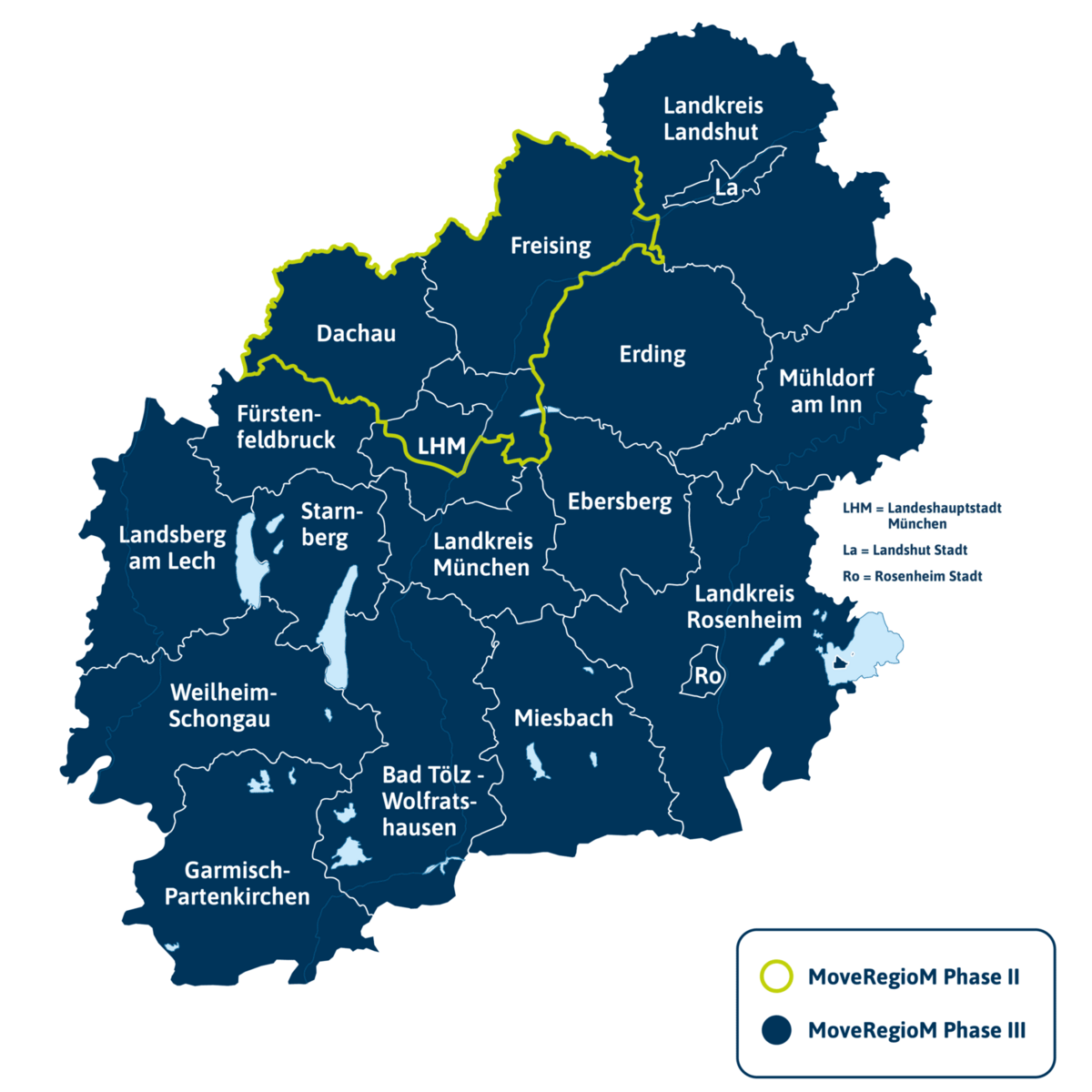
As can be seen on the map below, the project area in Phase III has been significantly expanded compared to Phase II.
Review of Phases I and II
In the first phase, the project developed a comprehensive mobility concept for Munich and the surrounding area. This involved all key stakeholders and modes of transport – from public transport to cycling and motoring. The aim was to examine the entire transport system in the region and work together to make it more sustainable and future-proof. As Munich is Germany’s commuting capital, cooperation across city and district boundaries was particularly important (Bavarian State Office for Statistics, 2023).
In the second phase, the mobility concept from Phase I was further developed and tested in practice within a selected study area. Various measures – tailored to different types of space – were implemented. These were technically supported, evaluated and, in some cases, already implemented. The focus was on the north of Munich, as this is where the strongest commuting patterns are recorded (ibid.).
Insight into Phase III
Phase III involves permanently implementing the measures tested in Phase II and extending them to other areas. Furthermore, the insights gained are to be utilised not only within the MVV area but also shared at a national level. To this end, a so-called ‘MoveRegioM mobility toolkit’ is being developed. This tool brings together all key findings from the first two phases and serves as a basis for disseminating successful concepts and applying them across the entire MVV area.
In addition to the results from Phase II, the mobility toolkit also includes advisory services and support from the project partners. Key components include the regional shared mobility concept, guidelines on mobility hubs and on-demand services, as well as recommendations for action in the old town. It also contains proposals on how mobility hubs, sharing services and cycling infrastructure can be better linked. Mobility hubs are central nodes within the MVV area where various transport options and services are bundled to facilitate transfers between modes of transport and thus promote environmentally friendly mobility.
Through a dedicated transformation management approach – featuring strategies for change, participation and communication – the mobility toolkit is being rolled out across the MVV area and the implementation of the measures is being supported.
Project partners and funding programme
MoveRegioM is part of the “MobilitätsWerkStadt2025” funding initiative by the Federal Ministry of Research, Technology and Space (BMFTR). Further information can be found via the link in the green info box below.
A diverse team of various partners is working together under the leadership of the City of Munich’s Mobility Department to ensure that MoveRegioM is more than just a pilot project. The insights gained are intended to form the basis for long-term implementation and further projects, which can also be expanded geographically. Key stakeholders involved include the City of Munich, Stadtwerke München (in Phases I and II), the Munich Transport and Tariff Association (MVV), the District of Munich (LKM), the European Metropolitan Region of Munich (EMM) and the University of the Federal Armed Forces in Munich (UniBW).
Further information (links)
University of the German Armed Forces on MoveRegioM
Federal Ministry of Research, Technology and Space (BMFTR) “MobilitätsWerkStadt 2025”
Accompanying research on sustainable mobility commissioned by the BMFTR
Accompanying research by the University of the German Armed Forces