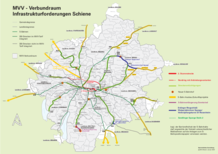
In 2020, the MVV member districts revised their position paper on the Munich S-Bahn. In it, they outline their vision for the future and development strategies for the further expansion of the S-Bahn in the Greater Munich area.
Working together for a more attractive Munich S-Bahn
(09/03/2020, press release)
Transport Minister Kerstin Schreyer emphasised at the handover of the position paper:
“The S-Bahn is the backbone of local transport. Together, we are making it fit for the future.”
Key concerns and statements in the position paper are:
- Handover of the position paper by the MVV network districts
- Clear support for the S-Bahn from the Free State and the districts
- Strengthening the outer branches and developing new transport solutions
The Greater Munich area is growing rapidly – and this is also reflected in the use of the S-Bahn. It was originally designed for around 250,000 people; today, up to 840,000 passengers use it daily. Against this backdrop, new solutions are needed to ensure the S-Bahn, as the backbone of local public transport, remains efficient and future-proof in the long term.
Transport Minister Schreyer emphasised:
“We must take the entire Greater Munich area into account in order to make the transport system even smarter. The districts and the MVV are key partners in this.”
The MVV network districts presented the Minister with their demands and ideas in the form of a position paper. Schreyer expressly thanked the districts for their commitment to public transport and emphasised that it was a shared goal to make the system reliable and future-proof. In doing so, all options must be considered – from underground extensions and cable car solutions to cross-connections. In her view, a significant acceleration of the expansion of the S-Bahn’s outer branches is particularly necessary.
The perspective of the districts themselves also became clear. Robert Niedergesäß, District Administrator of Ebersberg and spokesperson for the MVV network districts, explained:
“Numerous comments from commuters, who are confronted with the difficulties in the system almost daily, are for me both a challenge and a driving force to advocate for further and rapidly implementable improvements to the system.”
The then MVV Managing Director Dr Bernd Rosenbusch added:
“The Munich S-Bahn, with its main line in the city centre, is a major artery of transport – not only for the state capital, but also for the member districts of the transport association, particularly on the outer branches. Together with the feeder bus services, it forms the backbone of public transport in the MVV area. That is why it is crucial that we develop ideas together, implement them and continuously work to improve stability and service quality.”
The ideas and proposals from the position paper will be assessed and pursued as part of the “Munich Region Rail Expansion” programme. Minister Schreyer pointed out that the first position paper from 2017 had already been taken up. Currently, 40 measures are being examined for their feasibility and practicality, whilst a further 28 measures – including the second main line as a central element – are already in the planning or construction phase or have been implemented. Together with DB, MVV and the districts, numerous improvements have already been achieved, for example in the area of passenger information. At the same time, she made it clear:
“Particularly in the event of major disruptions, passenger information must be significantly improved.”